


The second day of the new F1 2026 Bahrain testing block in Sakhir reinforced a pattern already visible throughout pre-season running, headline lap times remain secondary to operational execution, programme discipline and structural reliability under the new technical regulations.
Thursday unfolded in two distinct phases, exploratory work in the morning and clearer performance indications in the afternoon, although any definitive competitive reading remains premature.
Morning: Norris leads as innovation defines the session
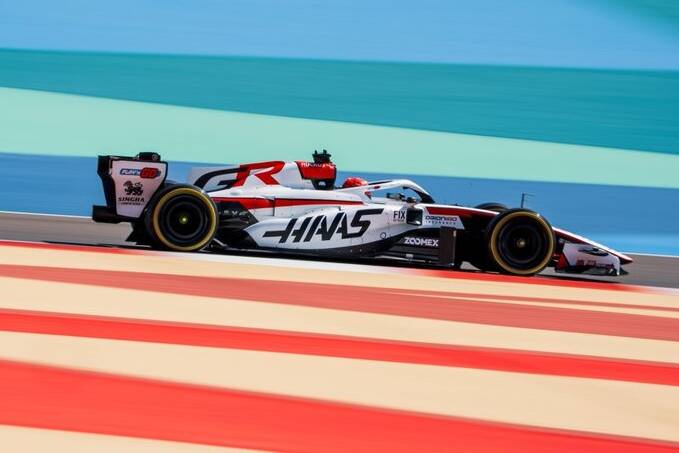
Lando Norris concluded the morning session fastest, recording a 1m33.453s lap and completing 72 tours. The McLaren driver finished ahead of Max Verstappen and George Russell, in a classification shaped by differing fuel loads, engine modes and programme priorities.
The principal technical talking point centred on Ferrari. The team introduced a revised rear wing concept allowing near-complete rotational movement around its own axis, an aggressive aerodynamic solution within the scope of the new regulations. Despite the innovation, Lewis Hamilton encountered operational issues and completed only five laps during the four-hour session, returning to the circuit only in the closing minutes.
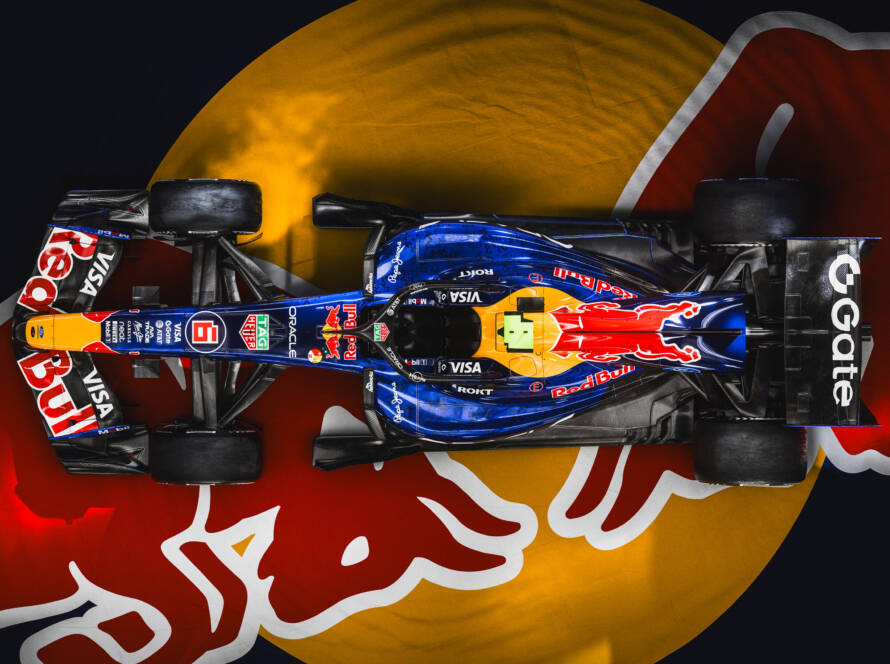
Red Bull focused on refinement work to the RB21, implementing changes to the sidepods, engine cover and floor. Verstappen conducted part of the programme with flow-vis applied to sections of the bodywork, underlining the analytical nature of the run plan. He completed 56 laps, while Russell recorded the highest mileage of the morning with 77 laps, highlighting Mercedes’ emphasis on data accumulation.
Cadillac also experienced a recovery session. Valtteri Bottas managed only two laps in the opening phase but significantly increased his running as the session progressed, concluding the morning with 58 laps in total.
Afternoon: Antonelli leads on penultimate day of testing
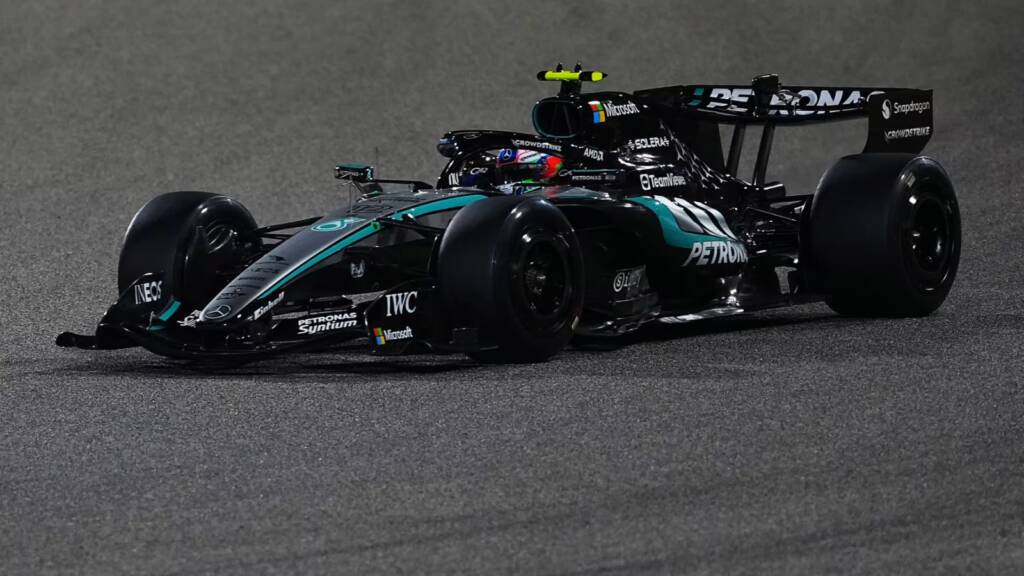
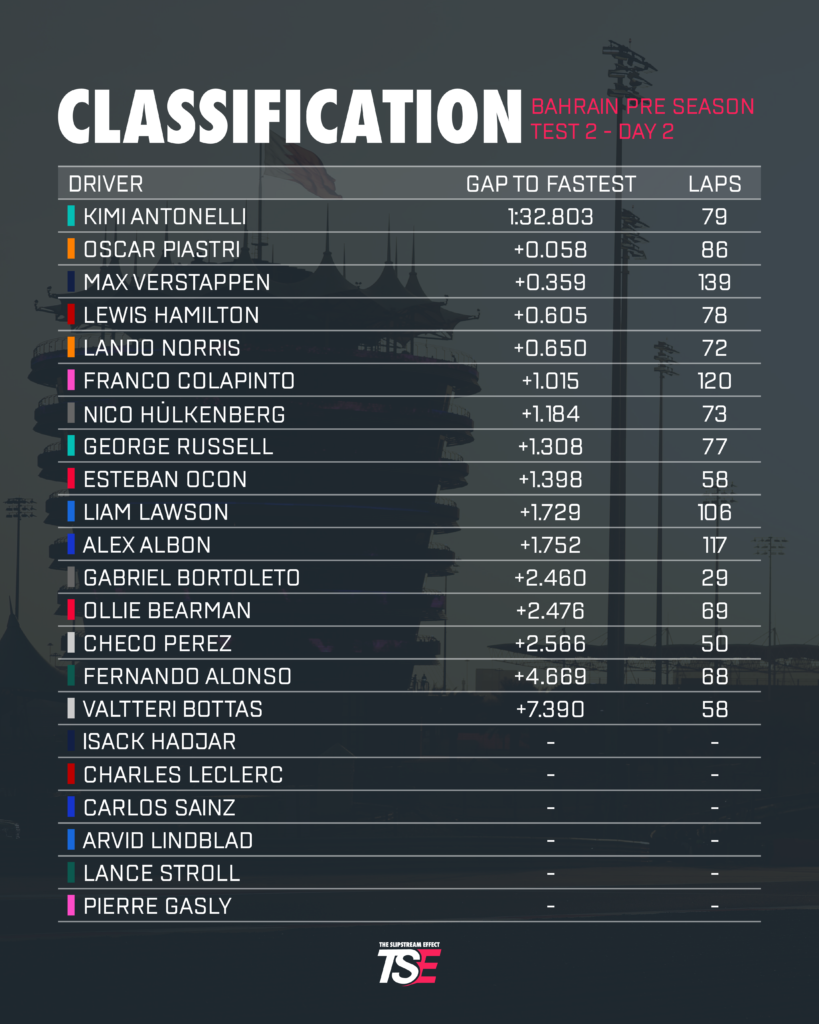
If the morning prioritised evaluation, the afternoon delivered more defined pace. Andrea Kimi Antonelli set a 1m32.803s lap to finish the day fastest overall. Oscar Piastri and Verstappen completed the top three as lap times evolved steadily throughout the session.
The opening hour remained relatively stable, although several minor off-track moments at Turns 10 and 11 reflected fluctuating grip conditions. Verstappen briefly held the benchmark before Piastri moved ahead after approximately 90 minutes. In the final phase, Antonelli secured the quickest time of the day.
The session was interrupted when Fernando Alonso stopped on circuit with a mechanical issue. Aston Martin required external assistance to recover the car, which returned to the pit lane under a black cover after roughly thirty minutes. Alonso did not resume running, compromising the team’s planned programme.
Hamilton, reverting to a more conventional rear wing configuration following the morning evaluation, responded with consistency, setting the fourth-fastest time and completing 78 laps, signalling Ferrari’s improved operational stability in the latter half of the day.
Cadillac again faced limited mileage, with Sergio Pérez completing only five laps during the early part of the afternoon. In contrast, Audi demonstrated structured execution, with Nico Hülkenberg securing the fifth-fastest lap of the day.
Development remains the central metric
Thursday’s running further confirms that at this stage of F1 2026 Bahrain Testing, understanding the car and executing clean programmes outweigh provisional timesheet positions.
While Norris and Antonelli topped their respective sessions, the more meaningful indicators lie in mileage consistency, aerodynamic validation and mechanical reliability. In Sakhir, comprehension continues to take precedence over headline pace.


1 Comment