


The first race of a new Formula 1 era rarely answers every question. But the Australian GP did reveal something important straight away: Mercedes arrived in 2026 ready.
George Russell converted pole position into victory at Albert Park, leading home team-mate Kimi Antonelli in a commanding Mercedes 1-2. Charles Leclerc completed the podium for Ferrari after a race defined by strategy, early chaos and the constant challenge of managing energy deployment in Formula 1’s new technical landscape.
Behind them, Lewis Hamilton finished fourth for Ferrari, ahead of Lando Norris and Max Verstappen, whose recovery drive from 20th on the grid provided one of the most revealing stories of the afternoon.
But the drama actually began long before the lights went out.
Melbourne shock before the race even started
The Australian GP lost one of its biggest storylines before the formation lap.
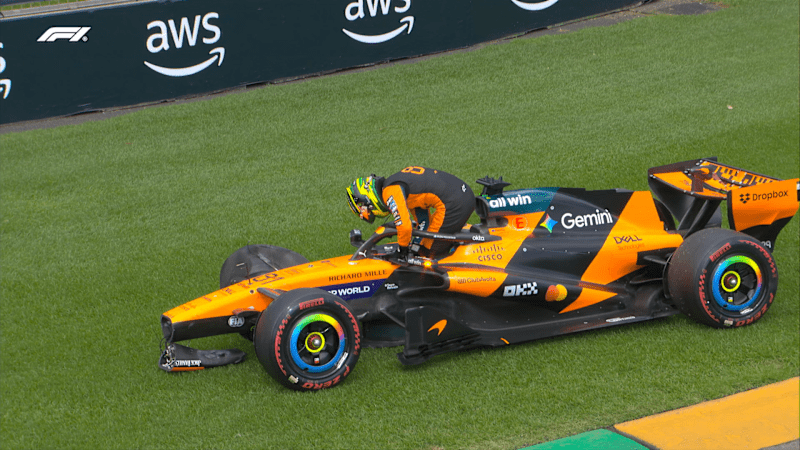
Oscar Piastri, starting fifth in front of his home crowd, crashed on his way to the grid after a small snap over the kerbs sent the McLaren into the barriers. The Melbourne crowd fell silent as the local favourite climbed out of the car, his race over before it had even begun.
It was a brutal moment for McLaren and for the fans who had arrived wearing papaya colours across Albert Park. More importantly for the race itself, it removed one of the drivers who looked capable of disrupting the Mercedes–Ferrari fight at the front.
With Piastri gone, the focus shifted entirely to the battle between Russell, Ferrari’s drivers and the unknown factor of Antonelli starting alongside his team-mate.
Ferrari strike first
If qualifying suggested Mercedes had the fastest car, the start reminded everyone that race launches still matter.
Leclerc rocketed off the line and swept past Russell into Turn 1, immediately reshaping the opening phase of the race. Hamilton almost followed him through as Russell struggled to deploy his energy cleanly, forcing the Mercedes driver into a defensive fight before the race had properly settled.
What followed over the first few laps was exactly the type of racing the new regulations were supposed to encourage. Russell and Leclerc exchanged the lead several times, using the new energy deployment system aggressively as the two drivers tested how closely these cars could follow.
Hamilton hovered just behind them, waiting for an opportunity, while Antonelli began recovering after a difficult launch that dropped him down the order.
For a moment, Ferrari looked like they might control the race.
Then strategy intervened.
The Virtual Safety Car that changed everything
The decisive moment of the Australian GP arrived when Isack Hadjar pulled off the track with a smoking power unit, triggering the first Virtual Safety Car.
Mercedes reacted instantly.
Russell and Antonelli were both brought in for hard tyres, committing early to what could become a one-stop race. Ferrari, by contrast, stayed out.
On paper the decision made sense. The race had barely settled into rhythm, and committing to a one-stop so early carried risk.
But the second VSC, triggered when Valtteri Bottas stopped near the pit lane entry, left Ferrari trapped in the worst possible scenario. The pit entry closed before the team could react, and when Leclerc and Hamilton eventually stopped under green flag conditions they lost more than twenty seconds.
From that moment the balance of the race flipped.
Mercedes now controlled the strategy, the pace and the track position.
Russell manages the race from the front
Once the pit stop cycle settled, Russell returned to the lead and began doing what championship contenders do best: controlling the race.
The Mercedes driver managed his tyres carefully, stretching the hard compound deep into the final phase while maintaining a comfortable gap over Antonelli. Ferrari’s drivers, meanwhile, found themselves fighting each other rather than the Mercedes ahead.
Hamilton closed steadily on Leclerc in the closing laps, but the fight for the podium ultimately ran out of time.
Russell crossed the line to win the Australian GP with the calm confidence of a driver who knew the race had slipped into his control long before the final lap.
“It was chaotic at the start,” Russell said afterwards.
“But the pace was there and once we got the strategy right the car felt great.”
It was a statement victory.
Not just for the driver, but for Mercedes.
Antonelli proves he belongs in the fight
If Russell’s victory confirmed Mercedes’ pace, Antonelli’s second place confirmed something equally important.
The Italian is not here to learn quietly.
Antonelli’s weekend had already been dramatic. A heavy crash in FP3 forced Mercedes into a major rebuild before qualifying, and a poor start in the race dropped him down the order.
But once the race settled, Antonelli recovered methodically. He managed the tyres effectively, rebuilt his position through strategy and eventually secured second place to complete the Mercedes 1-2.
For a driver still at the beginning of his Formula 1 career, the composure of the drive was as impressive as the result itself.
Russell may lead the championship after Melbourne, but Antonelli showed immediately that the intra-team fight at Mercedes will be real.
Verstappen’s recovery reveals another story
Max Verstappen’s race offered another kind of insight.
Starting from 20th after his Q1 crash, the Red Bull driver carved his way through the field to finish sixth. The recovery drive was strong, but it also served as a useful test of how the 2026 cars behave in traffic.
Overtaking proved possible, though not effortless. Strategy and tyre life still played major roles, and Verstappen ultimately ran out of time to challenge the leading group.
For Red Bull, the race hinted that the team may not yet have the outright pace to challenge Mercedes over a full race distance.
Strong performances further down the field
Away from the front, several drivers delivered performances worth noting.
Ollie Bearman finished seventh for Haas after a consistent race, leading the midfield group across the line. Arvid Lindblad, the youngest driver on the grid at 18, scored points on his Formula 1 debut with eighth place for Racing Bulls.
Gabriel Bortoleto delivered a strong ninth-place finish for Audi in the team’s first race with its new power unit, while Pierre Gasly completed the points in tenth.
Reliability issues removed several drivers from the race, including Hadjar and Bottas, while Fernando Alonso eventually retired after a difficult afternoon for Aston Martin.
What the Australian GP revealed about the 2026 season
One race never defines a championship.
But Australia offered an early outline of the competitive order.
Mercedes appear to have the fastest and most complete package at the start of the season. Ferrari are close enough to challenge but will need sharper strategic decisions if they want to convert race opportunities into victories.
McLaren and Red Bull remain within reach but, for now, seem half a step behind.
Just as importantly, the new cars have already produced the kind of racing Formula 1 hoped for. The early laps in Melbourne featured genuine wheel-to-wheel battles rather than processional management.
The season is only one race old, but the storylines are already forming.
Russell leaves Australia leading the championship. Antonelli has announced himself as a genuine contender inside Mercedes. Ferrari know they have the pace but also the work to do.
And the paddock now moves straight to China for the second round of the season.
If Melbourne was the introduction to Formula 1’s new era, it was a dramatic one.


2 Comments