From wet chaos to precise execution, the Brazilian rookie times his lap to perfection and leads a tightly contested FP2 in Madrid ahead of qualifying
Saturday morning at the Circuito de Jarama was defined by one key factor: adaptation. With the track still bearing the effects of overnight rain, Free Practice 2 for the Madrid E-Prix unfolded under technical, evolving and highly revealing conditions, particularly for one name increasingly establishing his presence in the paddock, Felipe Drugovich. The Brazilian driver for Andretti Formula E not only topped the timesheets, but did so with a composed reading of track evolution and precise timing as grip levels changed lap by lap.
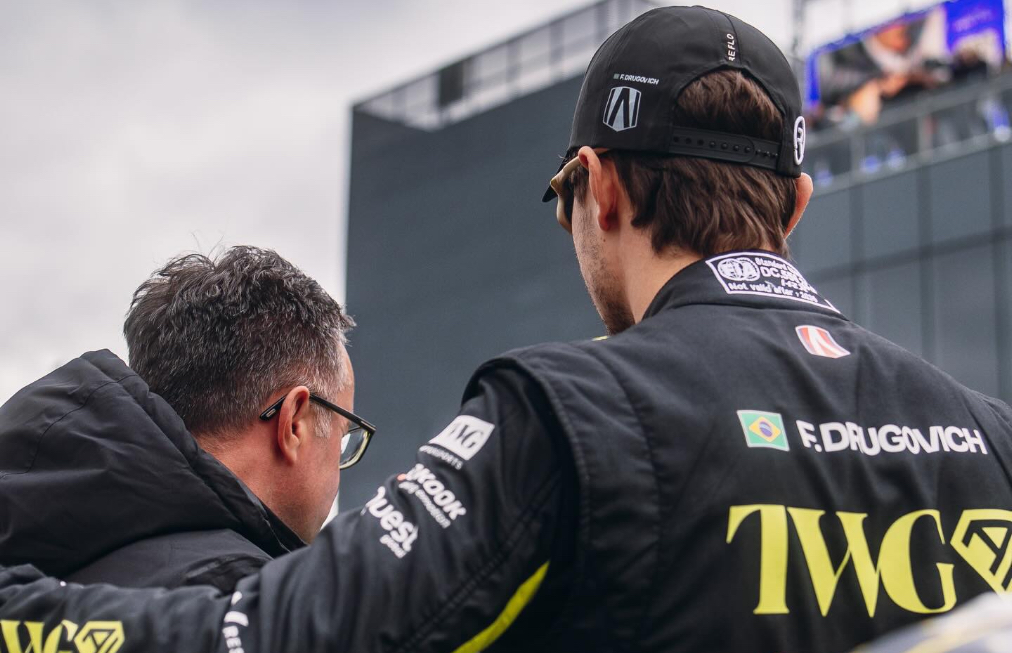
The session got underway at 08:30 local time, with Race Control declaring the circuit wet. That immediately set a cautious tone, as drivers focused on finding grip and building tyre temperature on a slippery and inconsistent surface. From the outset, cars appeared unstable under heavy braking and traction zones, with frequent corrections and a progressive approach adopted across the field. It was not simply about outright pace, but about understanding how the car responded to a track that offered very little predictability.
Track reading and execution put Drugovich on top
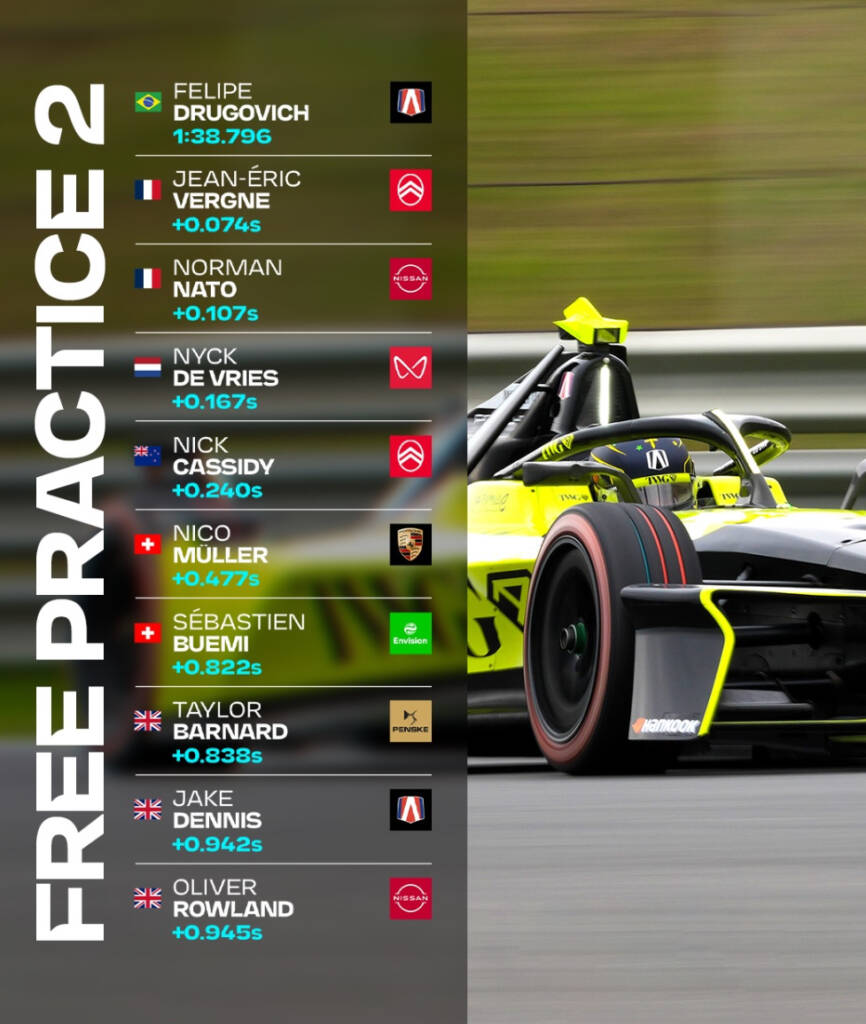
Within that context, Drugovich built his benchmark lap with precision. His 1m38.796s did not come immediately, but rather as a product of progressive adaptation, capitalising on the exact moment when grip began to improve without fully punishing the remaining damp sections. It was a lap that reflected maturity, controlled through the most slippery sectors and assertive where a dry line had begun to emerge. For a rookie in Formula E, the performance does more than attract attention, it firmly establishes intent ahead of qualifying.
There is also a symbolic layer to Andretti’s performance in Madrid. Jarama holds historical significance for the team, most notably through Mario Andretti, who once triumphed here during the Formula 1 era. Decades later, in a completely different competitive landscape, the team once again finds itself at the front on the same circuit, now in the electric era and led by a Brazilian driver. While the context has changed, the narrative continuity adds depth to the result.
Experience rises to the surface in mixed conditions
Behind Drugovich, the session highlighted the value of experience in variable conditions. Jean-Éric Vergne was the closest challenger, finishing just 0.074s adrift and demonstrating consistency in extracting performance from a tricky surface. Norman Nato followed, placing Nissan firmly in contention, while Nyck de Vries and Nick Cassidy completed the top five. The spread of manufacturers and teams underlines the competitive balance, but also reinforces that experience remains a decisive factor when track evolution plays such a critical role.
Limits exposed: excursions and warnings ahead of qualifying
Despite running uninterrupted, the session was not without its critical moments. Turn 1 in particular became a focal point, with its gravel trap catching out multiple drivers throughout the session. Among them were Lucas di Grassi and Jake Dennis, both experienced enough to avoid further consequences, yet still exposed to the difficulty of judging grip on a transitioning surface. These moments serve as a clear warning ahead of qualifying, this is a circuit that punishes even the smallest misjudgements.
Final minutes reshuffle the order as track evolves
If the opening phase was defined by caution, the closing minutes delivered intensity. As the circuit gradually dried, lap times began to fall significantly. At that stage, Nyck de Vries briefly moved to the top with a strong 1m38.963s, opening a notable gap to the rest of the field. However, the optimal performance window had not yet fully materialised.
As more drivers found improved conditions, a sequence of rapid laps reshaped the order entirely, turning the final moments into a pure exercise in timing. It was precisely in that phase that Drugovich secured his position. Crossing the line after the chequered flag, the Brazilian confirmed the fastest time of the session, having judged the track evolution to perfection.
Scenario outlook: what to expect from qualifying
The overall picture from FP2 points towards a qualifying session that will be highly sensitive to detail. Track evolution will be decisive, and finding the exact moment to deliver a lap could define the grid. At the same time, the competitive balance suggests there is no margin for error, minimal gaps are likely to translate into significant position changes.
In such a context, the combination of experience, adaptability and execution will be critical.
After an approximate three-hour break, drivers and teams will return to the track for the session that sets the starting grid. Drivers and teams return to the track for qualifying, which gets underway at 10:40 local time.