


There is a kind of magic that happens hours before lights out, and it has almost nothing to do with the cars. It is in the grandstands filling up at dawn. It is in a chant that has nothing to do with lap times. Ask anyone who has stood in a crowd at a Grand Prix and they will tell you the same thing: fan culture is not the backdrop to the racing. It is half the reason people keep coming back.
Six circuits, six very different ways of loving this sport. None of them look alike. All of them are saying roughly the same thing, just in different accents.
A sea of red
Start at Monza, because nowhere else does fan culture look quite like this. The Tifosi, Ferrari’s famously loyal supporters, turn the grandstands into a single sheet of red before a wheel has even turned. Flags the size of bedsheets. Rosso Corsa merchandise on every second person. A chant, “Forza Ferrari,” that rolls through the stands for a good lap time as readily as for a win.
Tifosi comes from tifo, the old Italian word for typhus. It is meant to describe support so intense it resembles a fever, and once you have heard 100,000 people singing for a team that has not won in years, the word starts to make uncomfortable sense.
When the chequered flag falls, the gates open and the crowd floods onto the tarmac to be near the podium, whoever is standing on it. In 2025, Kimi Antonelli became the first Italian to win at Monza since Ludovico Scarfiotti in 1966, driving for Mercedes rather than Ferrari, and the Tifosi cheered him anyway. Loyalty at Monza, it turns out, has room for national pride too.
An army in orange
Travel north to Zandvoort and red gives way entirely to orange. Since the Dutch Grand Prix returned to the calendar in 2021, the dunes around the circuit have belonged to Max Verstappen’s Orange Army: flares, tulip bouquets, inflatable lions perched on shoulders, and a noise that follows him lap after lap. It is one of the fastest fan culture movements the sport has ever produced, built almost entirely inside a single driver’s career.
The scale of it is genuinely hard to picture from a television screen. When Verstappen competed in the Nürburgring 24 Hours in 2026, the Dutch motoring association ANWB estimated that between 35,000 and 45,000 fans travelled to Germany just to watch, up from around 6,000 before his title-winning years began. That is not a fanbase following a driver. That is a driver who has become an occasion in his own right.
A stadium that was never built for this
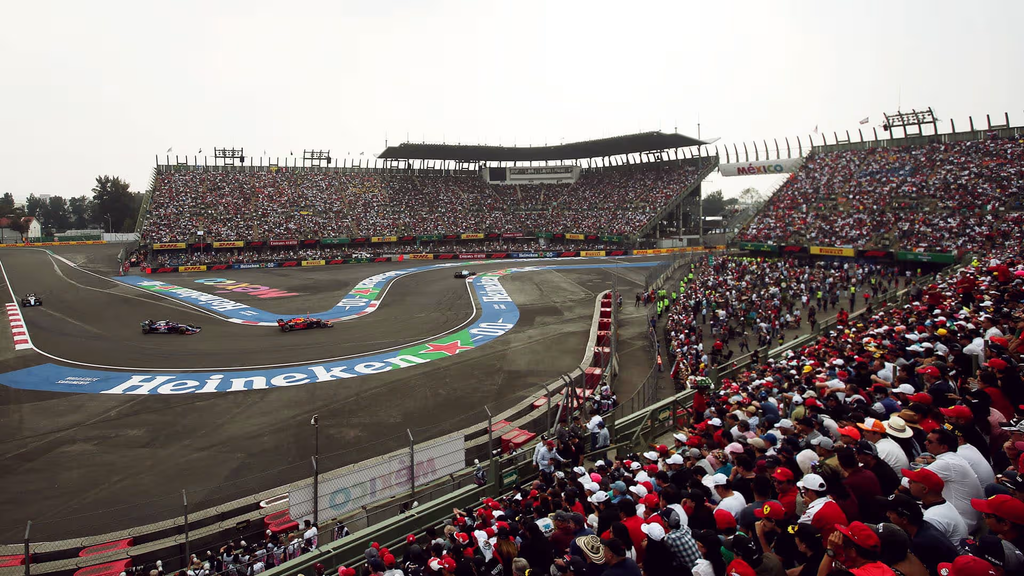
Mexico City does something no other circuit manages: it routes the final sector of the track straight through a repurposed baseball stadium. Foro Sol was never designed with Formula 1 in mind, yet 25,000 fans now pack its stands every year, and the podium ceremony happens inside it, surrounded on every side by noise.
The timing helps. The race regularly falls around Día de los Muertos, and the weekend absorbs it completely: sugar skulls, marigold garlands, traditional dress woven through the crowd without a hint of costume. This is fan culture with nothing manufactured about it. It is Mexico City doing what it always does in early November, with a Grand Prix slotted neatly inside it.
A weekend that doesn’t end
Silverstone plays a different game altogether: sheer numbers. The 2025 British Grand Prix drew 500,000 spectators on race day alone, the highest single-day attendance in the sport since the 2000 United States Grand Prix. A large share of them never leave the site all weekend. Campsites spring up around the circuit from Wednesday, and by Saturday night they run more like a music festival than a car park, complete with headline acts on a proper stage.
For a lot of British fans, the race itself is only ever a slice of the weekend. The rest is a shared, slightly damp, thoroughly loved kind of fan culture that has almost nothing to do with lap times either.
The quiet and the loud
Not every tradition needs volume to mean something. At Suzuka, fan culture takes its shape from restraint. There is no booing, no jeering, and a queue at a driver access point is something fans hold patiently rather than push against. Gifts get offered, never demanded. Drivers regularly admit they are caught off guard by how gently, and how completely, they are welcomed.
Interlagos sits at the opposite end of the dial, and somehow says the same thing. In Ayrton Senna’s era, fans queued for miles on foot down the hill to the circuit gates, samba bands keeping the line moving before dawn. Senna’s own 1991 win there, driven almost entirely in sixth gear with his body cramping, ended with him barely able to lift the trophy, wrapped in the Brazilian flag his fans had carried up that same hill.
More than three decades on, drivers still wear tributes to him at that circuit, and the crowd still shows up in numbers that outstrip almost anywhere else on the calendar.
Put Suzuka’s hush next to Interlagos’ roar and the contrast almost writes itself. But look closer and it is really the same instinct, dressed differently. Somewhere between the flags, the flares, and the long walk downhill, fan culture keeps proving that this sport was never just about who crosses the line first. It is about who is still there afterwards.


