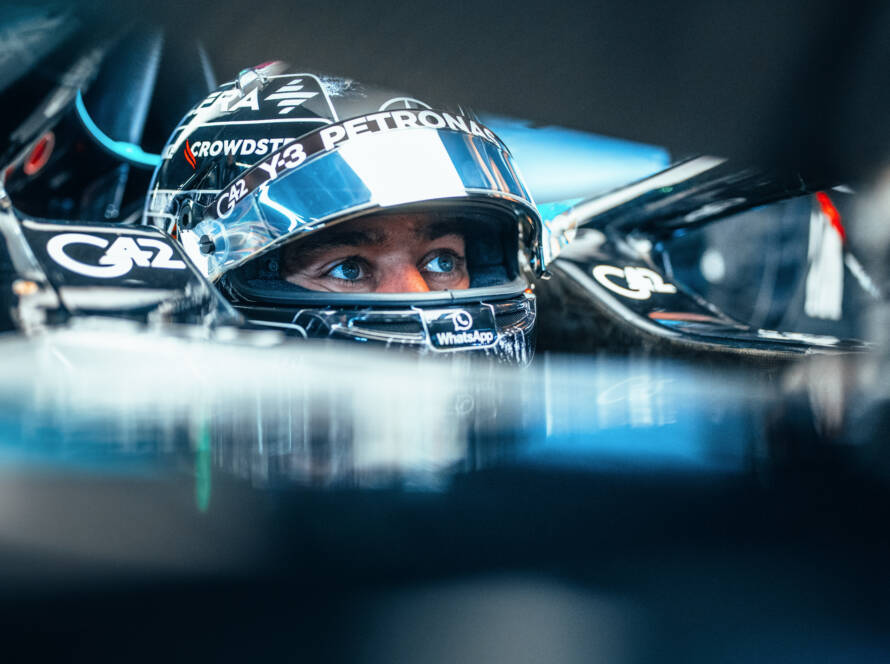
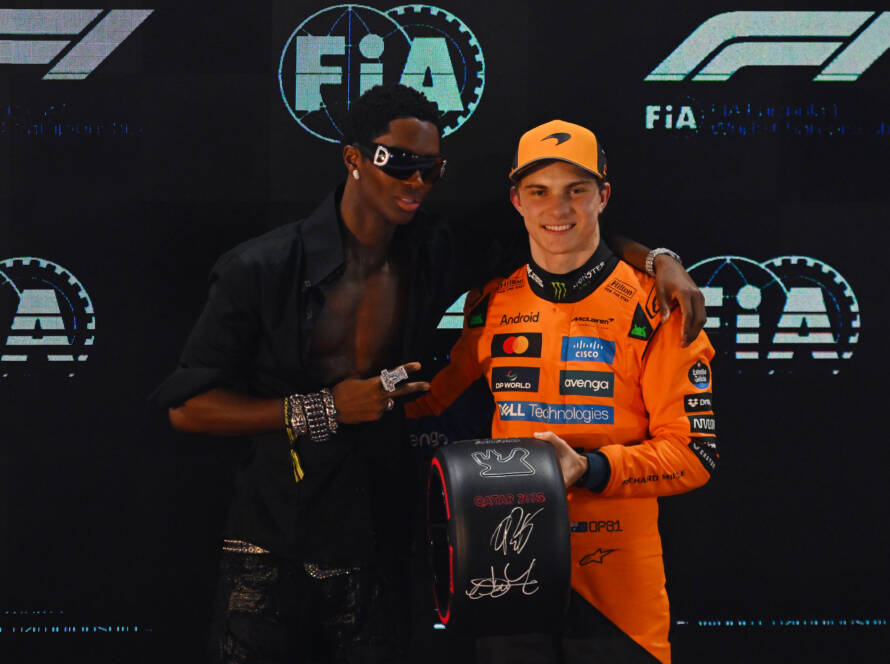
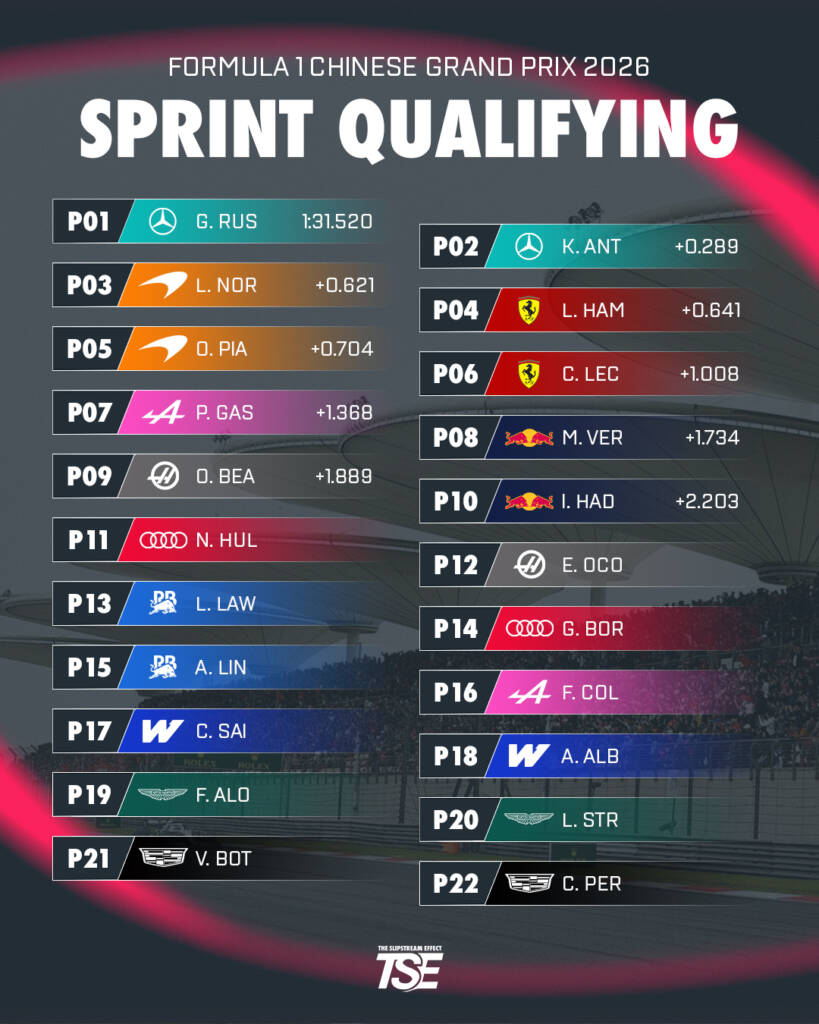
Formula 1’s first Sprint Qualifying session of the 2026 season confirmed what practice had already hinted at: Mercedes remain the benchmark, and George Russell is still the driver everyone else has to beat. Under the lights in Shanghai, Russell delivered another commanding lap to secure Sprint pole for the Chinese GP, leading home team-mate Kimi Antonelli in a Mercedes front-row lockout that once again underlined the team’s early advantage under the new regulations. Reuters reported Russell’s pole lap at 1:31.520, with Antonelli 0.289s back and Lando Norris a further three tenths adrift in third.
The result means Russell will start from the front for the second weekend in a row, after already taking pole and victory in Melbourne, and it leaves Mercedes looking increasingly settled at the front of the field. More than that, though, Sprint Qualifying at the Chinese GP exposed some of the key trends shaping the weekend so far: McLaren have moved closer, Ferrari remain dangerous without quite matching Mercedes over one lap, and Red Bull still look far from comfortable in Shanghai.
Mercedes turn early pace into another front-row lockout
If Friday practice suggested Mercedes had arrived in Shanghai with the strongest package, Sprint Qualifying confirmed it. Russell looked in control throughout the session, but it was the manner of the final lap that stood out most. Antonelli stayed close through the first two sectors in SQ3, only for Russell to open the gap decisively in the final part of the lap. It was the kind of finish that reflected a car working with the driver rather than being dragged to the limit by him.
That front-row lockout is especially significant on a Sprint weekend. With only one practice session before competitive running, there is little room to build into form gradually. Teams either understand the car quickly or they spend the rest of the weekend recovering. Mercedes clearly fell into the first category. Russell’s pace in the Chinese GP Sprint Qualifying session backed up his practice performance from earlier in the day, while Antonelli once again proved that his Melbourne result was no one-off. Reuters also noted that stewards investigated Antonelli for allegedly impeding Norris before deciding not to penalise him, allowing Mercedes to keep that front row intact.
McLaren edge Ferrari in the fight behind
One of the more meaningful shifts from Melbourne to Shanghai has been McLaren’s step forward over a single lap. In Australia, Ferrari had looked like the clearer second-fastest team, but Sprint Qualifying for the Chinese GP painted a more balanced picture. Norris took third and Oscar Piastri qualified fifth, both finishing ahead of the Ferraris, which placed McLaren firmly in the conversation behind Mercedes. Reuters reported that Norris beat both Ferrari drivers, with Hamilton fourth and Leclerc sixth.
That matters because Shanghai is not a circuit where lap time can be faked. The long corners, heavy braking zones and traction demands expose weaknesses quickly, and McLaren looked far more comfortable than they had at times in Melbourne. Norris said after the session that third was effectively the maximum available given Mercedes’ pace, which felt like a fair reading of the competitive picture. The gap to Russell was still substantial, but the internal battle just behind Mercedes now appears much tighter.
Ferrari, meanwhile, remain close enough to stay relevant, but not yet close enough to control the story. Hamilton once again showed strong one-lap speed and ended up fourth, while Leclerc was sixth, leaving the Scuderia on rows two and three for the Sprint. That is not a disastrous outcome, especially with Ferrari’s stronger starts still in mind, but it does reinforce the idea that the team is currently chasing rather than dictating terms.
Red Bull’s struggles continue in Shanghai
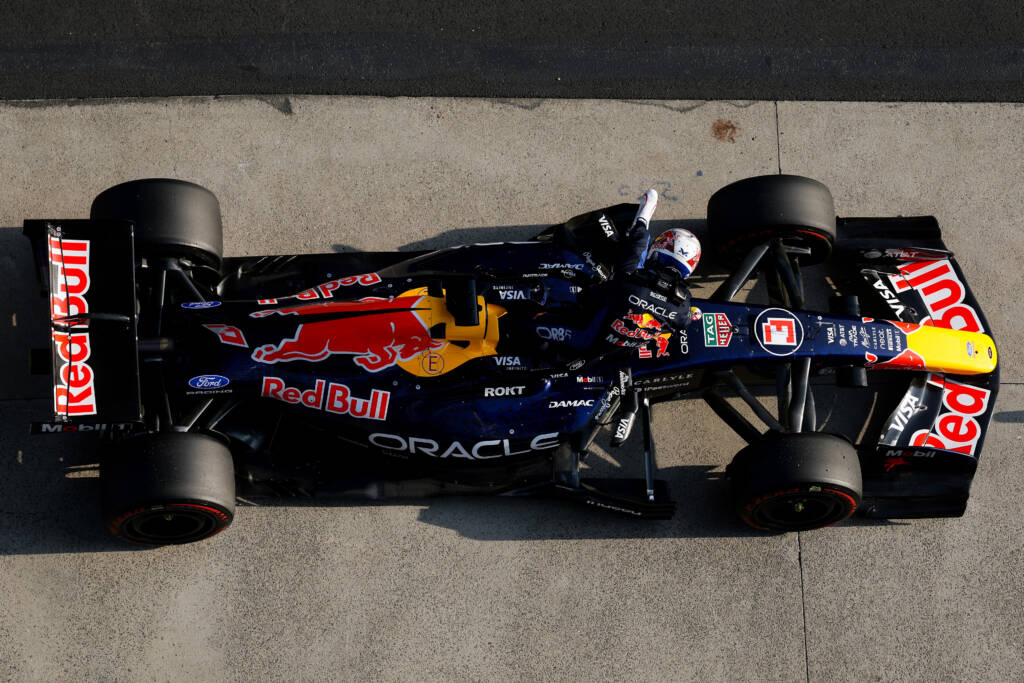
If Mercedes left Sprint Qualifying looking increasingly assured, Red Bull did the opposite. Max Verstappen could only qualify eighth for the Chinese GP Sprint, while Isack Hadjar rounded out the top 10. For a team used to operating at the sharp end, that is a worrying result on a circuit where confidence under braking and through long direction changes is essential. Reuters described Red Bull as lacking pace in Shanghai, and the numbers backed that up. Russell’s final margin to Verstappen was well over a second.
The session itself never really suggested Red Bull were about to unlock something dramatic. Verstappen scraped through SQ2 and then failed to make a meaningful impression in the final shootout, while Hadjar’s route to SQ3 was solid rather than spectacular. Put simply, the car does not yet look like one that can be placed exactly where the drivers want it. And in a format as compressed as Sprint weekends, unresolved balance issues tend to become even more costly.
That leaves Red Bull vulnerable not just to Mercedes, McLaren and Ferrari, but also to the best of the midfield. Pierre Gasly out-qualified Verstappen in seventh, while Oliver Bearman also made SQ3 for Haas, continuing a quietly impressive start to the season.
The midfield fight remains one of the weekend’s best stories
Beyond the front four teams, the Chinese GP has already developed a strong secondary narrative in the shape of the midfield fight. Haas, Alpine, Audi and Racing Bulls all looked capable of reaching SQ3, but only a handful of slots were realistically available once the top teams got both cars through. That pressure made every lap in SQ2 feel decisive, and the margins were predictably tiny.
Gasly was one of the standout performers of the session, taking seventh for Alpine and beating Verstappen in the process. Bearman’s ninth place was another strong result for Haas, reinforcing the impression that the team has started the season with a genuinely competitive baseline. Audi were less fortunate. Nico Hulkenberg missed out on SQ3 by just 0.015s, which was a painful margin but also evidence that the car has enough pace to trouble the top ten on the right weekend. Those details matter because the midfield does not currently look separated by tenths. It looks separated by moments.
Arvid Lindblad, by contrast, never really had the chance to recover from his disrupted Friday. After losing almost all of FP1 to a mechanical issue, the Racing Bulls rookie was eliminated in SQ2. On a normal weekend that would still be frustrating. On a Sprint weekend, where early running carries even more weight, it is a much heavier blow.
Perez’s absence adds to the disorder at the back
The most unusual part of the session came before it had even really begun. Sergio Perez was unable to take part in Sprint Qualifying because of a fuel system issue on his Cadillac, meaning he was classified last without setting a time. Reuters confirmed that the problem could not be repaired in time for the session.
That absence helped shape the elimination zones in SQ1, where both Williams cars dropped out along with both Aston Martins and Valtteri Bottas. For Williams in particular, it was another frustrating session after Sainz had already lost time in practice. Across a Sprint weekend, these repeated disruptions can quickly spiral because there is no spare session left to reset the direction of the car.
The Sprint start could change everything
For all Mercedes’ strength in Sprint Qualifying, the Chinese GP Sprint itself may still look less straightforward than the grid suggests. There are no mandatory pit stops, only 19 laps to work with, and overtaking tools remain a major factor under the 2026 rules. That means the start matters enormously, especially with Ferrari still expected to launch strongly off the line and McLaren looking close enough to apply pressure immediately.
Russell himself admitted after the session that Mercedes had worked since Melbourne on improving their starts, which is one of the few areas where they looked vulnerable at the opening round. If that weakness has been reduced, pole becomes even more valuable. If not, the Sprint could quickly turn into a multi-car fight at the front.
That is what makes this Chinese GP so interesting already. Mercedes still have the fastest car over one lap, and Russell is driving with the assurance of someone who knows exactly where the limit is. But McLaren have taken a step, Ferrari remain dangerous in race conditions, and Red Bull’s struggles have opened the door for the midfield to apply pressure from unexpected places. Sprint Qualifying may have given Russell pole, but it also set up a Saturday race that still feels wide open.