


The final day of Bahrain F1 Testing reinforced one of the key conclusions of pre-season running: more than isolated headline lap times, the real focus has been on operational consistency, programme execution and reliability under the new technical regulations.
Split between morning and afternoon sessions, Friday in Sakhir featured two Mercedes drivers at the forefront and provided a clearer indication of each team’s level of preparation, even if the competitive hierarchy remains undefined following F1 2026 Bahrain Testing.

Morning: Russell sets the pace in steady session
George Russell ended the final morning of F1 2026 Bahrain Testing at the top of the timesheets, ahead of Lewis Hamilton and Max Verstappen. While the lap placed him as the provisional reference, context remains crucial: differing fuel loads, engine modes and run plans make direct performance comparisons unreliable at this stage.
The session featured only one significant interruption, caused by a mechanical issue on Valtteri Bottas’ Cadillac. The Finn returned close to the final hour, limiting the team’s track time. Aside from that stoppage, the morning unfolded in a relatively controlled manner.
Following the restart, Russell set the benchmark lap and remained at the top until the chequered flag. Given reports of power unit concerns earlier in the week, the performance offered a signal of stability for Mercedes at a decisive point in F1 2026 Bahrain Testing.
There were also minor incidents without lasting consequences: Gabriel Bortoleto and Liam Lawson both ran wide at the final corner, while Oscar Piastri locked up during a push lap, routine moments within experimental test programmes.
Afternoon: Antonelli underlines Mercedes’ progress
If the morning suggested consistency, the afternoon confirmed performance. Kimi Antonelli posted a 1m33.669s lap to conclude F1 2026 Bahrain Testing with the fastest time of the third day, ahead of Russell and Hamilton on the combined classification.
The Italian moved to the top just over two hours into the session, running shorter, more focused stints. He completed 49 laps, significantly fewer than Oscar Piastri’s 153 across the day, as the McLaren driver concentrated on longer simulations and race-run data collection.
The closing minutes featured two red flags. Hamilton stopped his Ferrari at Turn 8 due to a fuel-related issue, while Franco Colapinto ran onto the grass on the main straight during a practice start. As both incidents occurred late in the session, neither materially disrupted the afternoon’s overall running.
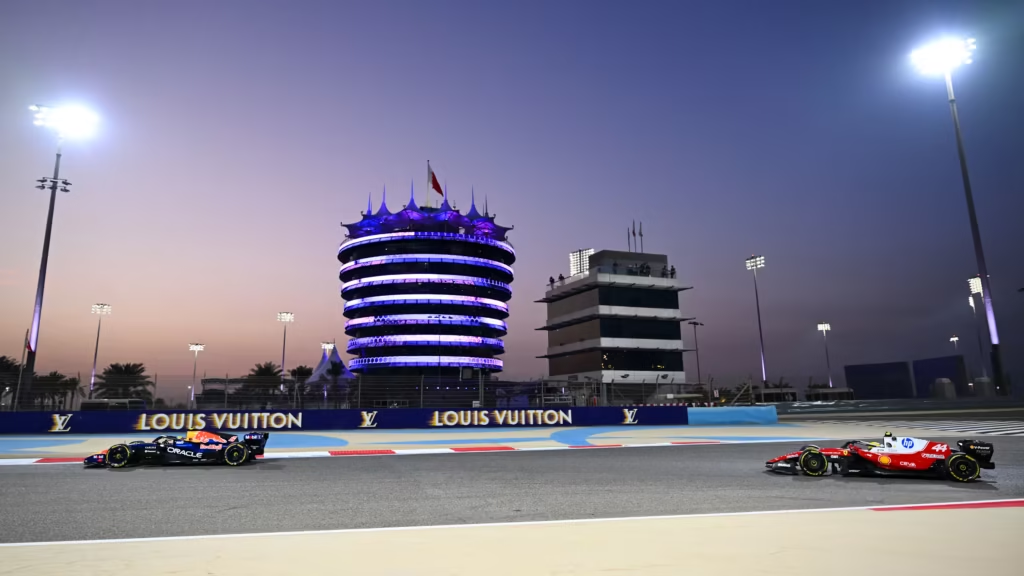
Mileage highlights strategic priorities
When analysing the full three days of F1 2026 Bahrain Testing, total mileage provides a more meaningful indicator than headline lap times.
McLaren and Williams completed 442 laps each over the week, underlining strong structural reliability. Ferrari followed with 421 laps, balancing data gathering with performance exploration. Haas accumulated 390 laps, while Aston Martin recorded 206, the lowest total of the field, potentially reflecting technical limitations or a more focused evaluation programme.
Within that broader context, Mercedes combined two crucial elements on the final day of F1 2026 Bahrain Testing: competitive pace and clean programme execution. Although not leading overall mileage for the week, the team demonstrated steady progression after facing technical questions earlier in the test.
Early signals, but no defined order
The overall picture from F1 2026 Bahrain Testing concludes without establishing a definitive pecking order. Mercedes ended the week with the fastest time of the final day, McLaren demonstrate robustness in cumulative mileage, and several teams alternate between long-run simulations and targeted performance runs.
Under a new regulatory cycle, development trajectory is likely to prove more decisive than any single pre-season benchmark. In Sakhir, it became clear that understanding the car remains the priority, and at this stage, comprehension may matter more than topping the timesheets.


