


F2 Barcelona testing officially launched the 2026 Formula 2 season with a fascinating opening day at the Circuit de Barcelona-Catalunya. While lap times in pre-season never tell the full story, Day 1 already revealed important early signals about pace, adaptation and long-run execution ahead of Melbourne.
Campos Racing’s Noel León ended the day quickest overall, but the broader picture of F2 Barcelona testing suggests a tightly packed field, varied run programmes and plenty still to unfold.
Here are five crucial takeaways from Day 1.
1. Noel León and Campos Racing send a statement
The headline from F2 Barcelona testing was clear: Noel León finished fastest overall with a 1:24.370 in the afternoon session.
Campos Racing looked sharp across both sessions. León’s pace on soft tyres came late in the day, just before a red flag caused by Sebastian Montoya ended proceedings early. The timing suggests a qualifying-style simulation, but the consistency behind the headline lap matters just as much.
After finishing fifth in the morning, León improved as the track evolved. That adaptability is significant. Barcelona traditionally rewards drivers who can extract performance as grip builds, and Campos appeared comfortable reacting to those conditions.
Early testing times do not define championships. But F2 Barcelona testing has already shown that Campos will not be passive observers in 2026.
2. Morning belonged to Stenshorne and Rodin
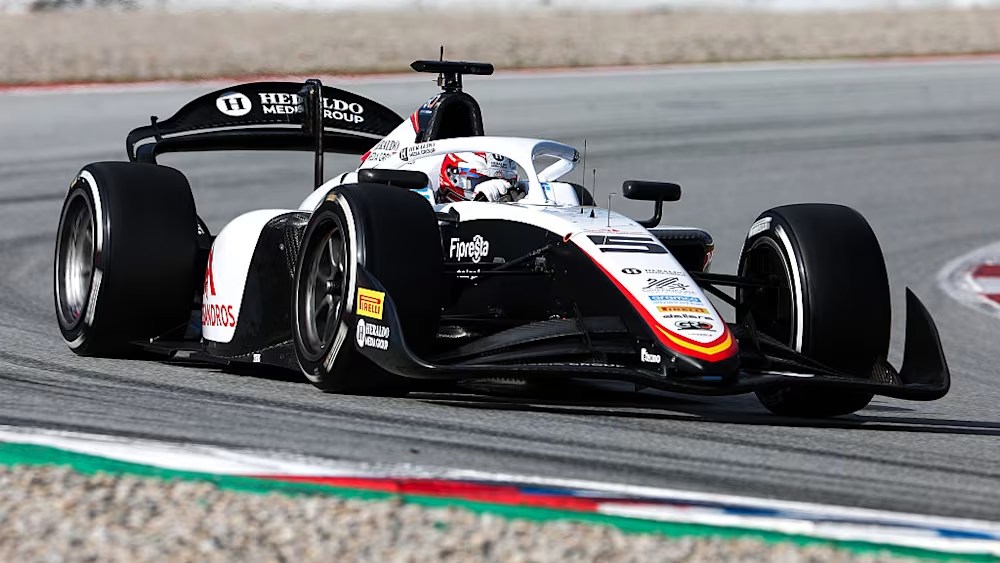
Before León’s late surge, Martinius Stenshorne led the morning session with a 1:25.437 for Rodin Motorsport.
Rodin’s performance across the morning was one of the strongest collective displays of F2 Barcelona testing so far. Alexander Dunne followed his teammate closely, finishing just 0.015s behind.
That margin matters. When teammates operate within hundredths during early testing, it often reflects solid baseline balance rather than random lap-time spikes.
The Rodin package looked stable through the medium-speed sections, particularly Turns 3 and 9, both critical indicators of chassis confidence in Barcelona.
3. Red flags disrupt rhythm
F2 Barcelona testing Day 1 was interrupted three times by red flags.
Nikola Tsolov stopped on track in the morning, Joshua Duerksen spun at Turn 3 in the afternoon, and Montoya’s gravel excursion at Turn 1 brought the session to an early close.
While disruptions are common in testing, they heavily influence run plans. Teams building long-run data lose valuable correlation laps when interruptions occur.
Several outfits had already shifted focus to race simulations by mid-afternoon. The second red flag, in particular, halted multiple long stints just as degradation trends were beginning to emerge.
That makes Day 2 of F2 Barcelona testing even more important for teams seeking uninterrupted mileage.
4. Soft tyres introduce first performance clues
Duerksen was the first driver to bolt on the soft compound tyre during the afternoon, briefly going quickest before León’s benchmark.
Soft tyre usage is often the first real performance indicator in F2 Barcelona testing. Even without knowing fuel loads, the pace differential begins to reveal who can switch on the tyre efficiently.
Several drivers showed strong one-lap bursts, including Nicolás Varrone and Tasanapol Inthraphuvasak, both breaking into the top group late in the day.
However, what remains unclear is relative fuel strategy. Barcelona testing historically features varied run plans, meaning some drivers may still be operating above representative race fuel loads.
5. Adaptation stories are already emerging
One of the most intriguing elements of F2 Barcelona testing is driver adaptation.
Colton Herta, entering the season with significant attention, remained over a second from the ultimate pace. That is not unusual for a driver transitioning fully into the F2 environment, but it highlights how steep the adaptation curve remains.
Meanwhile, Rafael Câmara, the reigning F3 champion, appeared measured rather than explosive. Testing is about systems understanding rather than immediate headlines, and several rookies seemed to prioritise installation and consistency over raw speed.
That pattern reinforces the central theme of F2 Barcelona testing Day 1: this is about data accumulation before Melbourne.
Full Top 10 – Day 1 F2 Barcelona Testing
- Noel León – 1:24.370
- Nicolás Varrone – 1:25.058
- Joshua Duerksen – 1:25.274
- Ritomo Miyata – 1:25.583
- Martinius Stenshorne – 1:25.712
- Tasanapol Inthraphuvasak – 1:25.802
- Alexander Dunne – 1:25.882
- Rafael Câmara – 1:25.928
- Nikola Tsolov – 1:25.995
- Colton Herta – 1:26.025
What F2 Barcelona testing tells us
Pre-season testing is rarely about hierarchy. It is about execution.
Day 1 of F2 Barcelona testing showed:
- Campos Racing operating confidently
- Rodin demonstrating early balance
- Long-run programmes interrupted but underway
- Soft tyre pace beginning to define margins
- Several rookies focused on controlled integration
With two more days remaining, the pecking order will likely shift. Track evolution, run-plan variation and fuel simulations will continue to distort surface impressions.
But if Day 1 proved anything, it is this: the 2026 Formula 2 season will not begin quietly.
F2 Barcelona testing has already delivered pace, unpredictability and early narrative tension. And this is only the first chapter before Melbourne.

1 Comment