


The opening Free Practice session in Jeddah marked the official start of one of the most distinctive weeks on the Formula E calendar. Rounds 4 and 5 of the ABB FIA Formula E World Championship bring the series back to Saudi Arabia for a night-time double header that also concludes the opening stretch of the season.
Unlike a standard race week, on-track action began on Thursday, reflecting the compressed and carefully structured schedule required for two races in just three days.
Set along the Red Sea coastline, the Jeddah Corniche Circuit is among the fastest tracks Formula E visits. At 3.001km, the layout combines long straights with sweeping high-speed corners, bordered closely by concrete walls that leave no margin for error. Running exclusively at night, the circuit demands precision, strong spatial awareness, and a refined understanding of energy deployment. Free Practice 1 was held at 20:00 local time, mirroring race conditions almost exactly, with lights out scheduled for 20:05 on both race days.
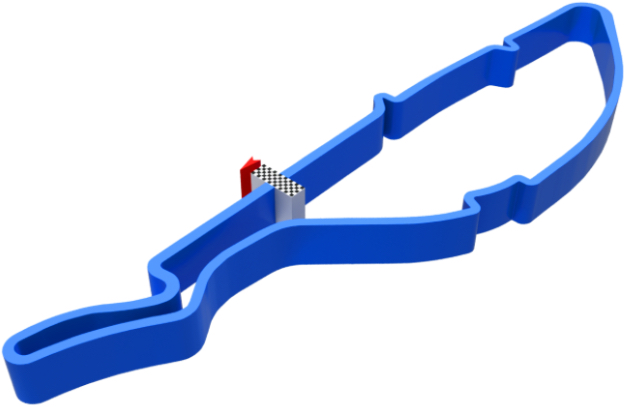
Representative conditions raise the value of Free Practice 1
From the outset, the session carried more significance than a conventional opening practice. With track conditions closely aligned to those expected during the races, teams treated the run as a genuine reference point rather than a simple systems check. Almost the entire grid took to the circuit immediately, underlining the importance of gathering representative data as early as possible in a double-header weekend.
This approach also increased the level of on-track congestion, with cars running different programmes and energy targets simultaneously. Managing traffic quickly became one of the defining challenges of the session.
Günther leads as DS PENSKE continues its strong Jeddah form
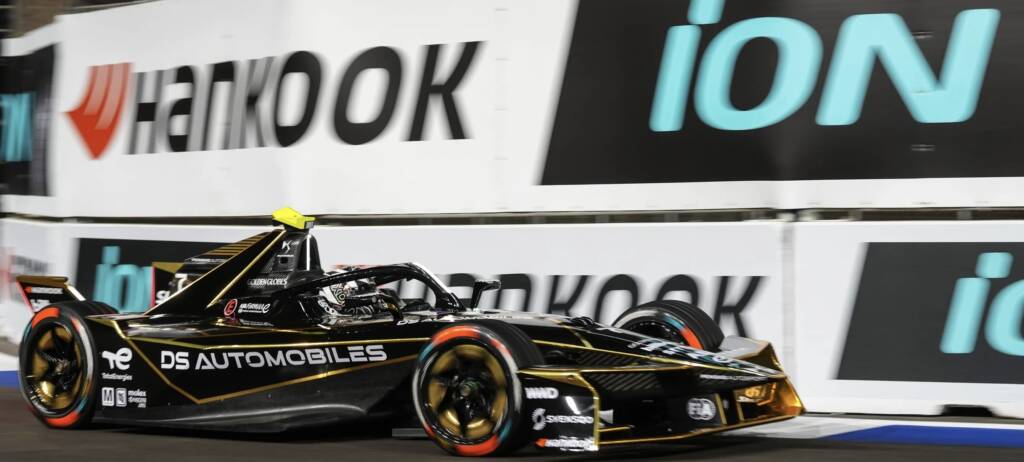
DS PENSKE emerged as the early benchmark in the first session, continuing its strong association with the Jeddah circuit. Maximilian Günther, winner of last year’s race at this venue, topped the timesheets with a best lap of 1m15.714s, immediately positioning himself as a key contender for the weekend.
The German’s performance combined outright speed with composure in traffic, a crucial skill on a circuit where clean laps are difficult to find. His pace reinforced the sense that DS PENSKE arrives in Jeddah well prepared to repeat last season’s success at the venue.
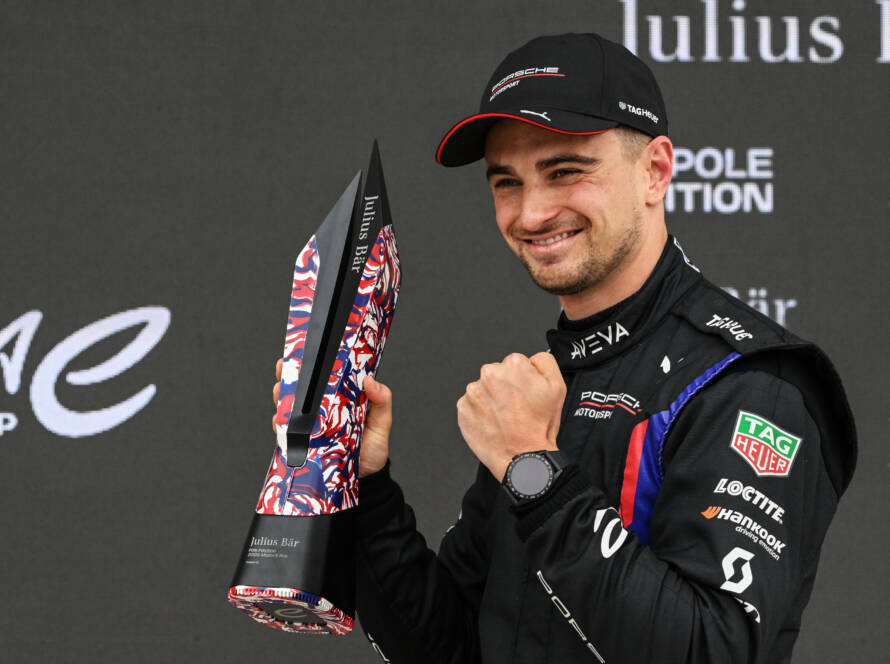
Pascal Wehrlein placed Porsche second, maintaining the team’s consistent form in the early stages of the championship. Jake Dennis followed closely in third for Andretti, while Edoardo Mortara delivered a competitive fourth position for Mahindra Racing. Mitch Evans completed the top five for Jaguar TCS Racing, once again showing strength on high-speed street circuits.
Traffic, close calls and early technical concerns
The nature of the Jeddah layout ensured that traffic played a central role throughout the 40-minute session. Several drivers encountered impeding situations, particularly during the closing minutes as attempts to set fast laps intensified.
One of the most notable moments came when reigning World Champion Oliver Rowland and DS PENSKE’s Taylor Barnard narrowly avoided contact near the end of the session. The incident underlined just how quickly situations can escalate on a track defined by speed and limited visibility.
Earlier in the session, Barnard had reported balance issues over the radio, describing increasing understeer through high-speed left-hand corners. While the initial balance felt acceptable, the problem became more pronounced as speed increased, shifting the team’s focus toward setup refinement rather than lap time. The comments carried added weight given that Barnard secured his first Julius Baer Pole Position at this circuit last season.
A constantly shifting timesheet
At the halfway point, all drivers had recorded representative laps, with Nico Müller briefly leading the session for Porsche on a 1m16.261s. CUPRA KIRO also enjoyed a strong phase, as Pepe Martí and Dan Ticktum occupied second and third positions, highlighting the competitiveness of the midfield.
In the final ten minutes, leadership changed again. Norman Nato moved Nissan to the top of the times, with Miami race winner Mitch Evans close behind for Jaguar. As grip levels improved and energy strategies aligned, a final sequence of improvements followed, culminating in Günther reclaiming first place with the fastest lap of the session.
Traffic issues remained until the very end. Martí was involved in another close moment, this time impeding two-time champion Jean-Éric Vergne. Although the rookie immediately apologised, the incident was noted by the stewards, reinforcing the emphasis on clean conduct even during practice.
Early signals ahead of Free Practice 2
One of the most telling details of Free Practice 1 in Jeddah did not appear on the timing screens. Lucas di Grassi was the only driver who did not take part in the early running, choosing instead to remain in the garage to focus on PIT BOOST simulations. With the feature still relatively new in Formula E, and particularly influential in tightly scheduled double-header events, the decision underlined how strategic preparation is increasingly shaping practice priorities. While others chased lap time, di Grassi’s programme highlighted a parallel reality of the session: understanding race tools can be just as important as outright pace.
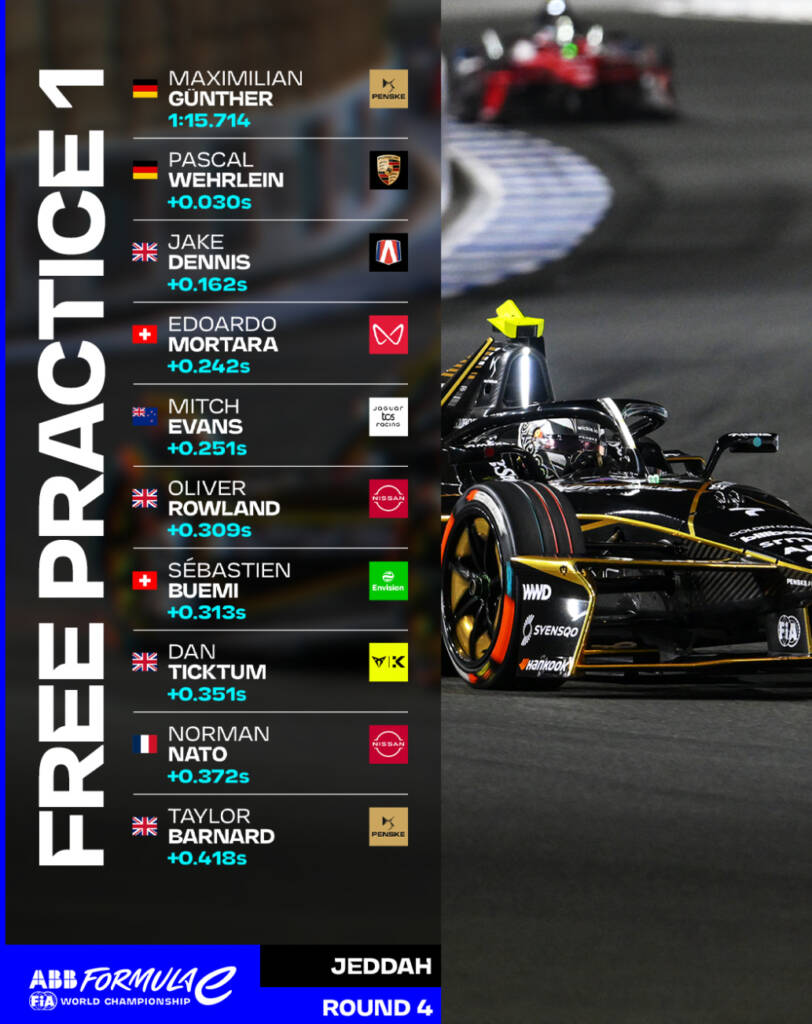
On track, however, the stopwatch told a story of remarkable compression. Maximilian Günther emerged as the clear reference with a 1m15.714s lap, a benchmark that already sits comfortably within competitive territory for the weekend. Yet the headline was not the time itself, but the margins behind it. In a session run under conditions closely mirroring race night, the gaps suggested a field operating within extremely fine limits.
Pascal Wehrlein’s second place, just 0.030s adrift, was almost symbolic. Such a marginal difference points to DS PENSKE and Porsche working at near-identical levels of performance, particularly in high-speed conditions where efficiency and balance are critical. It also hints that leadership may be highly fluid as the weekend unfolds, with small setup changes or cleaner laps capable of reshuffling the order.
Jake Dennis followed in third, 0.162s off the pace, keeping Andretti firmly in the conversation.
The fact that the top three were separated by less than two tenths reinforces the impression of a tightly matched leading group, rather than a single team imposing early control.
That pattern extended seamlessly into the rest of the top five. Edoardo Mortara placed Mahindra Racing fourth at +0.242s, with Mitch Evans close behind for Jaguar TCS Racing at +0.251s. The gap between fourth and fifth was negligible, and more importantly, both remained within a quarter of a second of the fastest time. On a fast and demanding circuit like Jeddah, that margin suggests genuine front-running potential rather than opportunistic positioning.
From first to fifth, the entire group was covered by just 0.251s, an unusually small window given the length and speed of the circuit. It is an early indication that outright pace is widely distributed, and that race-defining factors may emerge from execution rather than raw performance.
The midfield within the top ten told a similarly compelling story. Oliver Rowland finished sixth at +0.309s, immediately followed by Sébastien Buemi at +0.313s. The near-identical deltas highlight how closely Nissan and Envision are matched in one-lap pace, even as both teams continue to refine their broader race programmes.
Dan Ticktum’s eighth place at +0.351s kept CUPRA KIRO within striking distance of the established frontrunners, an encouraging sign given the team’s recent trajectory. Norman Nato placed ninth for Nissan at +0.372s, while Taylor Barnard completed the top ten at +0.418s. Even at the edge of the top ten, the deficit remained under half a second, reinforcing the sense of an exceptionally balanced session.
Taken together, the numbers paint a clear picture. The minimal gap at the front suggests that no single driver or team holds a decisive advantage. The compressed top ten indicates that multiple manufacturers are capable of competing for leading positions, while the absence of a dominant outlier points toward a weekend likely to be shaped by detail, timing and adaptability.
Free Practice 1 rarely defines outcomes on its own, but in Jeddah it has provided meaningful early signals. DS PENSKE and Günther carry momentum into the next phase, yet Porsche, Jaguar, Andretti, Mahindra, Nissan, Envision and CUPRA KIRO all appear firmly within the competitive window. As attention now turns to Free Practice 2, the expectation is less about outright breakthroughs and more about refinement — managing traffic, optimising energy deployment and extracting precision on a circuit where the margins are already razor-thin.
If FP1 was any indication, the fight for position in Jeddah is unlikely to be settled by pace alone.


3 Comments