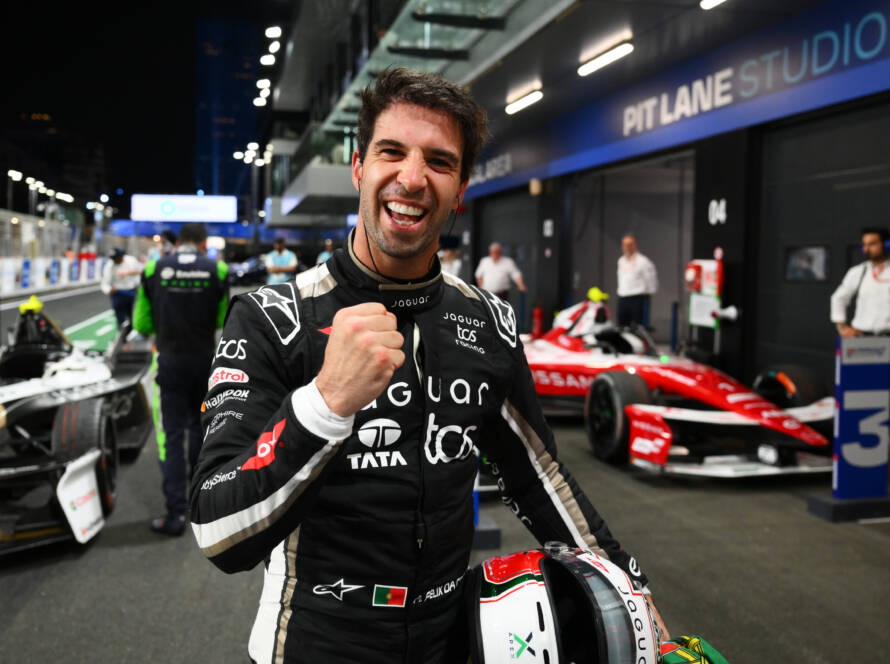
The Penske duo completes the top four, with Nikita Bedrin leading the way
The Rookie Test session in Madrid offered more than just a snapshot of emerging talent in Formula E. It also reinforced broader performance patterns across teams, particularly highlighting Mahindra’s continued strength in Spanish conditions and raising questions about how much of that pace translates into race weekends.
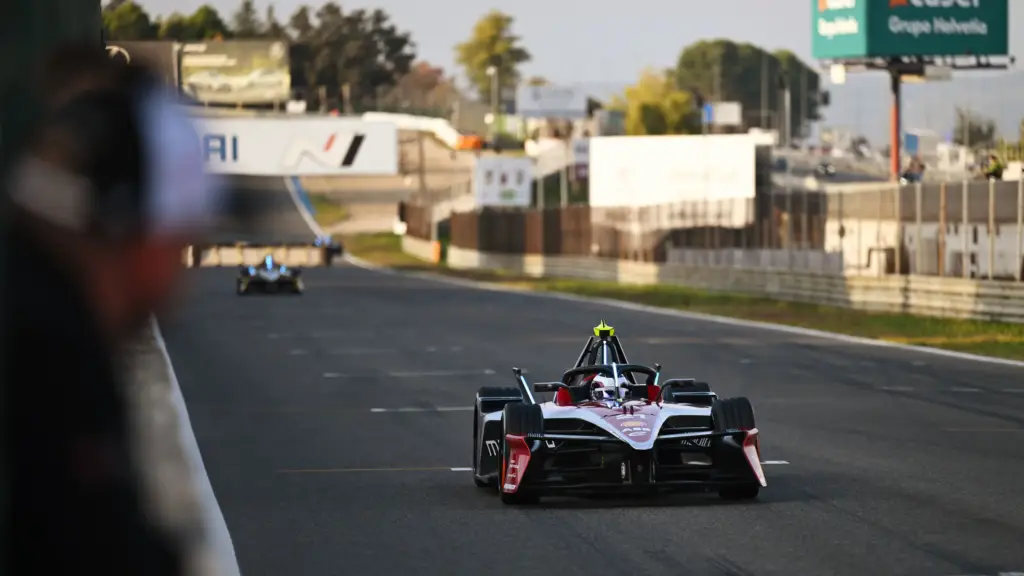
Mahindra confirms strong form on Spanish soil
Mahindra once again emerged as the benchmark of the session, securing a 1–2 finish with Théophile Nael leading the way in 1:29.216, closely followed by Kush Maini just two-tenths behind. While rookie tests must always be interpreted with caution due to varying programmes and fuel usage, the consistency of Mahindra’s presence at the sharp end across multiple Spanish-based sessions is difficult to ignore.
The team has now featured prominently not only in this Rookie Test, but also in the Women’s Test and previous pre-season running with race drivers. Taken together, this suggests a clear pattern: the Mahindra package appears particularly well suited to the characteristics of Spanish circuits, whether due to track surface evolution, temperature windows, or aerodynamic efficiency in these conditions. The recurring competitiveness points to a strong baseline setup that allows the car to quickly reach an optimal operating window.
Penske remains firmly in contention
Behind Mahindra, Penske delivered a solid and controlled performance, with Nikita Bedrin and Daniil Kvyat finishing third and fourth respectively. The gap to the leaders, ranging between four and seven tenths, is notable but not necessarily alarming given the nature of a rookie test session.
In this context, Penske’s showing can be interpreted as both stable and methodical. It is entirely plausible that the team prioritised structured run plans and data collection over outright performance, a common approach in testing environments where long-run correlation and systems evaluation often take precedence over headline lap times.
Midfield gaps highlight mixed programmes
From fifth place onwards, the field became increasingly spread out, with gaps stretching from just under a second to nearly two seconds. This dispersion is typical of rookie-focused sessions, where drivers are often working through vastly different programmes, energy management targets, and adaptation phases.
Some drivers were likely prioritising race simulation and consistency, while others focused on single-lap performance. As a result, the timing sheet reflects not only pace differences but also the diversity of objectives across teams and drivers. This makes direct comparisons more complex, particularly in a category like Formula E where energy strategy plays such a central role.
Mahindra’s recurring pattern: testing strength vs race execution
Beyond the headline result, the most intriguing narrative remains Mahindra’s broader performance profile. The team has consistently demonstrated strong pace in testing environments, particularly in Spain, yet this has not always translated into comparable results during race weekends.
This divergence suggests a gap between raw performance and competitive execution. On one hand, the car clearly possesses the potential to operate at the front under optimal conditions. On the other, Formula E demands far more than outright speed, with energy management, strategic timing, Attack Mode deployment, and racecraft often proving decisive.
Execution remains the deciding factor
Two possible explanations emerge from this pattern. The first points toward operational execution, where strategic decisions and in-race management may be limiting the conversion of pace into results. The second suggests a narrower performance window, meaning the car performs exceptionally well under specific conditions but becomes more sensitive when variables are introduced over a full race distance.
In either case, the underlying message is consistent: the pace is present, but not yet fully maximised.
Clear potential, unfinished execution
The Madrid Rookie Test ultimately reinforced a familiar storyline for Mahindra. The team appears to have a competitive package, particularly effective in Spanish conditions, and capable of topping sessions when circumstances align. However, the key challenge remains unlocking that performance consistently across the full complexity of a Formula E race weekend.
If the team can bridge the gap between testing performance and race execution, Mahindra’s current trajectory suggests it could evolve from occasional frontrunner to a consistent threat at the sharp end of the grid.
With the initial data collected, the drivers will soon return to the track for the second session.