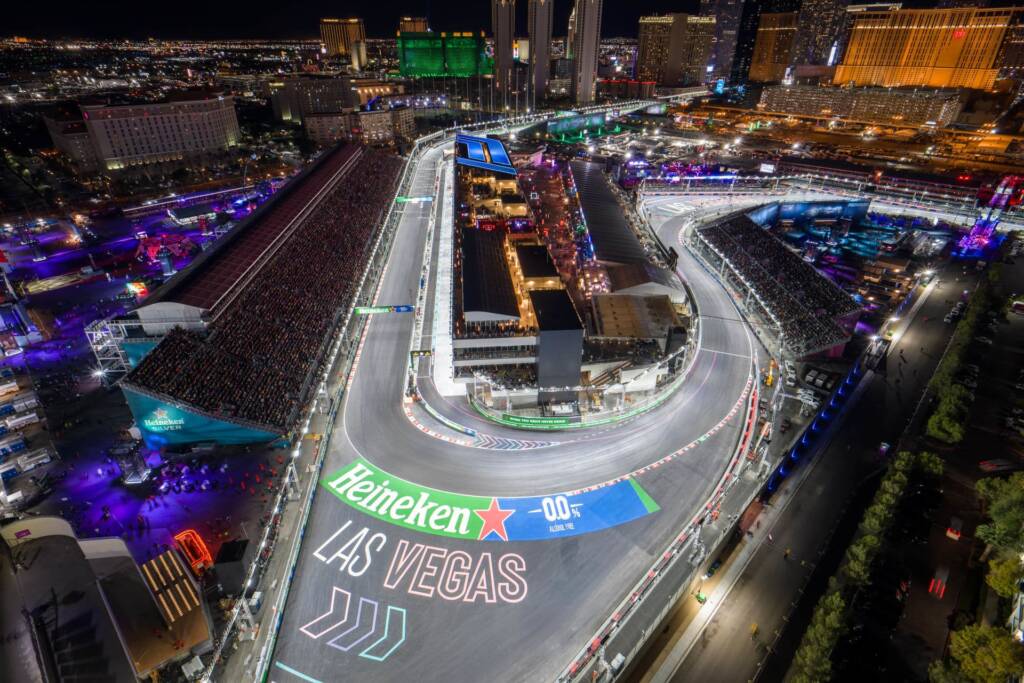
The roar of engines, the glow of floodlights, and the glamour of global spectacle. Formula 1 has never been more visible. From the neon-lit streets of Las Vegas to the desert circuits of the Middle East, the sport is expanding at speed. Yet beyond the podium celebrations lies a more uncomfortable question: the ethics of F1. As the calendar grows, so too does the tension between profit, politics, and principle.
A truly global sport or a global business?
Formula 1’s transformation over the past decade has been striking. Once centred on European circuits, the sport now spans five continents, targeting new audiences and markets with increasing precision.
Under Liberty Media, expansion has become a strategic priority, with races in Saudi Arabia, Qatar, and multiple venues in the United States reflecting both ambition and commercial opportunity.
Hosting a Grand Prix is lucrative. Governments reportedly pay substantial fees for the privilege, while cities hope for a surge in tourism, global visibility, and investment. In this context, race locations are not just sporting decisions but calculated economic choices.
Formula 1 is no longer merely a championship. It is a travelling business platform, which makes the ethics of F1 increasingly difficult to separate from financial incentives.
The argument for racing everywhere
Supporters of F1’s global reach often point to its potential as a force for positive engagement. Hosting a race can accelerate infrastructure development, create jobs, and place emerging destinations on the world stage. For countries seeking diversification, particularly those less reliant on traditional industries, sport offers a powerful vehicle for transformation.
There is also a broader philosophical argument centred on engagement rather than isolation. By bringing a global audience and international scrutiny, Formula 1 could in theory encourage openness and gradual change. From this perspective, the ethics of F1 are not about exclusion, but about presence and influence.
At the same time, some argue that sport should remain separate from politics altogether. Teams and drivers are competitors, not policymakers, and expecting them to act as moral arbiters may be unrealistic. In a globalised world, drawing clear ethical boundaries is rarely straightforward.

The challenge of sportswashing and human rights
Critics argue that Formula 1 cannot avoid political implications, particularly when racing in countries facing international scrutiny.
The term “sportswashing” has become central to the debate, describing how governments use high-profile sporting events to enhance their international image while diverting attention from domestic issues such as restrictions on political freedoms or labour rights.
Formula 1’s presence in certain regions has drawn criticism for this reason. Critics question whether the spectacle of a Grand Prix, broadcast to millions, serves to normalise or obscure deeper concerns. In this context, the ethics of F1 are not just theoretical, but tied directly to real-world consequences.
There is also the issue of consistency. Some host nations face intense scrutiny while others do not, raising questions about whether ethical concerns are applied evenly or shaped by political and economic convenience.
Who holds responsibility?
Responsibility within Formula 1 is shared across multiple actors. The FIA governs the sport, while commercial decisions largely sit with Formula 1’s management. Both operate within a system shaped by financial incentives, which makes prioritising values over revenue a complex challenge.
Teams and sponsors must also navigate this landscape. Association with controversial events can carry reputational risks, yet withdrawing from races may not be commercially viable. This tension highlights how the ethics of F1 are often negotiated rather than firmly defined.
Drivers, meanwhile, have increasingly used their platforms to speak on social issues. However, their influence remains limited by contractual obligations and the collective nature of the sport, which constrains individual action.
Defining the ethics of F1
If Formula 1 is to address these tensions, a more structured approach may be required. An ethical hosting framework based on criteria such as human rights standards, transparency, and measurable local impact could provide greater consistency and accountability.
While such a system would not eliminate controversy, it could make decision-making more transparent and defensible.
However, this introduces a difficult trade-off. Stricter standards could limit the number of viable host countries, potentially reducing revenues and slowing expansion. For a sport that has embraced growth as a central objective, formalising the ethics of F1 would represent a significant shift.
Ultimately, the question is not simply whether Formula 1 should race anywhere, but what it is prepared to stand for. Complete neutrality may be impossible in a sport so deeply embedded in global business and politics.
What remains is a balancing act between engagement and responsibility, where every decision reflects not just where Formula 1 races, but who it chooses to be.