


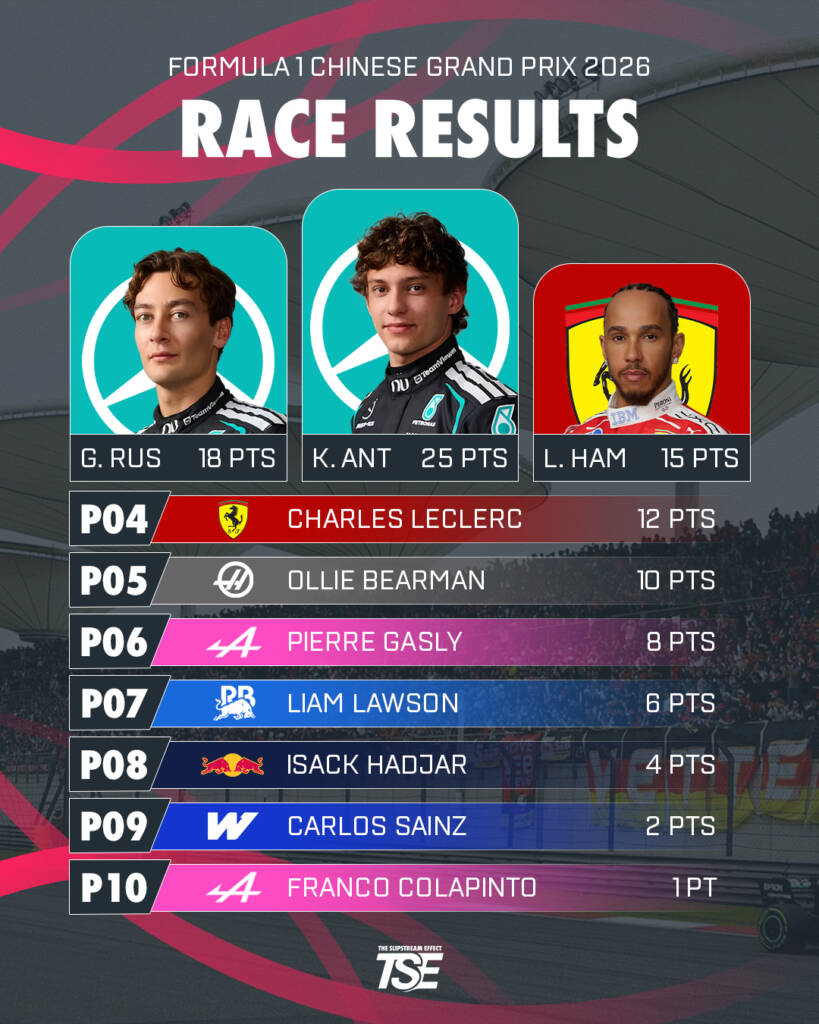
Kimi Antonelli’s pole position had already turned the Chinese GP into a major moment in the early 2026 season. His race win made it something bigger. At just 19, the Mercedes driver controlled the Grand Prix in Shanghai to take his first Formula 1 victory, becoming the second-youngest winner in the history of the sport and leading home George Russell to complete a Mercedes one-two. Lewis Hamilton finished third to secure his first Grand Prix podium for Ferrari, while Charles Leclerc followed in fourth after another intense intra-team battle between the Scuderia drivers.
The result matters for more than the headline. It confirms that Mercedes have started the new regulation cycle with the strongest overall package, but it also changes the internal shape of the title fight almost immediately. Russell still leaves the Chinese GP leading the standings, yet Antonelli is now only four points behind after two rounds, which is exactly the sort of margin that turns a team advantage into an intra-team championship question. Reuters reported the four-point gap after Shanghai, and that feels significant not because the season is old, but because Mercedes no longer look like a team with one leader and one apprentice.
Mercedes had the pace, but Antonelli delivered the control
Shanghai was not a straightforward lights-to-flag drive dressed up as a breakthrough. Antonelli had to recover the lead after losing out to Hamilton at the start, absorb the pressure that followed, and then manage a race shaped by tyre wear, traffic and a Safety Car that arrived early enough to complicate strategy rather than simplify it.
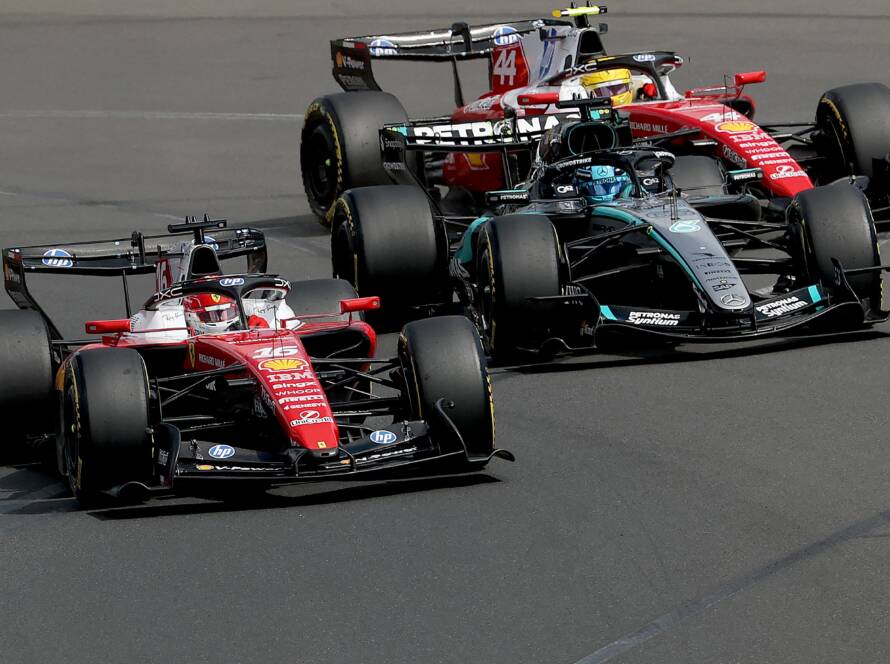
Hamilton’s launch immediately tested the Mercedes pole-sitter, with Ferrari once again showing how sharp it can be off the line. The seven-time World Champion swept around the outside into Turn 1 to take the lead, and for a moment the race threatened to become another example of Ferrari seizing the initiative even when Mercedes had started in front. Antonelli’s response was what changed the tone. Rather than allowing the opening phase to get away from him, he settled quickly and reclaimed the lead with an assertive move at the hairpin on Lap 3.
That overtake mattered because it reset the race on his terms. From there, Antonelli began to look less like a teenager protecting track position and more like a driver already comfortable dictating a Grand Prix from the front.
The Safety Car created the strategic pressure point
The race’s biggest strategic shift came on Lap 10 when Lance Stroll stopped and triggered a Safety Car. By then, tyre graining and degradation were already shaping the conversation, particularly around whether the hard compound could realistically go to the end. Mercedes and Ferrari both committed to the one-stop route, double-stacking their drivers and moving onto hards, knowing that the timing was not ideal but was still too good to ignore.
That decision turned the second half of the race into an extended tyre management exercise. It also reshuffled the field around those who had started on hard tyres and stayed out, briefly creating a mixed-order race in which the frontrunners had to work back through traffic while still protecting their tyres. Antonelli handled that phase best. Russell remained close enough to keep some pressure on, but he never looked more comfortable than his team mate on the same strategy.
What stood out most was Antonelli’s rhythm. He did not need constant defensive driving or an aggressive sequence of laps to hold control. He simply managed the race better than everyone else. Even when Russell chipped away slightly, the gap remained stable enough to suggest Antonelli was always managing the situation rather than reacting to it.
Ferrari were competitive, but not quite enough
Ferrari leave the Chinese GP with reasons for optimism and a reason for frustration. Hamilton’s third place delivered his first Grand Prix podium since joining the team and confirmed that Ferrari are not far away on race pace, especially when the car is in a good operating window. Leclerc’s fourth place, combined with the pair’s pace on the hard tyre, reinforced that idea.
At the same time, the race underlined the gap that still exists to Mercedes. Leclerc admitted afterwards that the main negative from the afternoon was exactly that. He enjoyed the battle with Hamilton, but Ferrari were ultimately fighting each other for the final podium place rather than genuinely threatening the team that controlled the race.
That intra-team fight was one of the highlights of the Grand Prix. Hamilton and Leclerc traded positions repeatedly in a contest that felt hard, fair and evenly matched. It also revealed something useful about Ferrari’s current position. The car is competitive enough to race Mercedes in moments, but not consistently enough to force the issue across a full distance. When the two Ferraris started scrapping, Antonelli was able to edge further away, and Russell could begin stabilising second place behind him.
Hamilton still had every reason to leave with encouragement. His race pace was strong, his battlecraft was sharp, and a first Ferrari Grand Prix podium is a meaningful step in establishing his place inside the team. But Ferrari’s overall takeaway should still be that they need more if they are going to stop Mercedes from controlling weekends rather than just contesting parts of them.
A race shaped before it even started
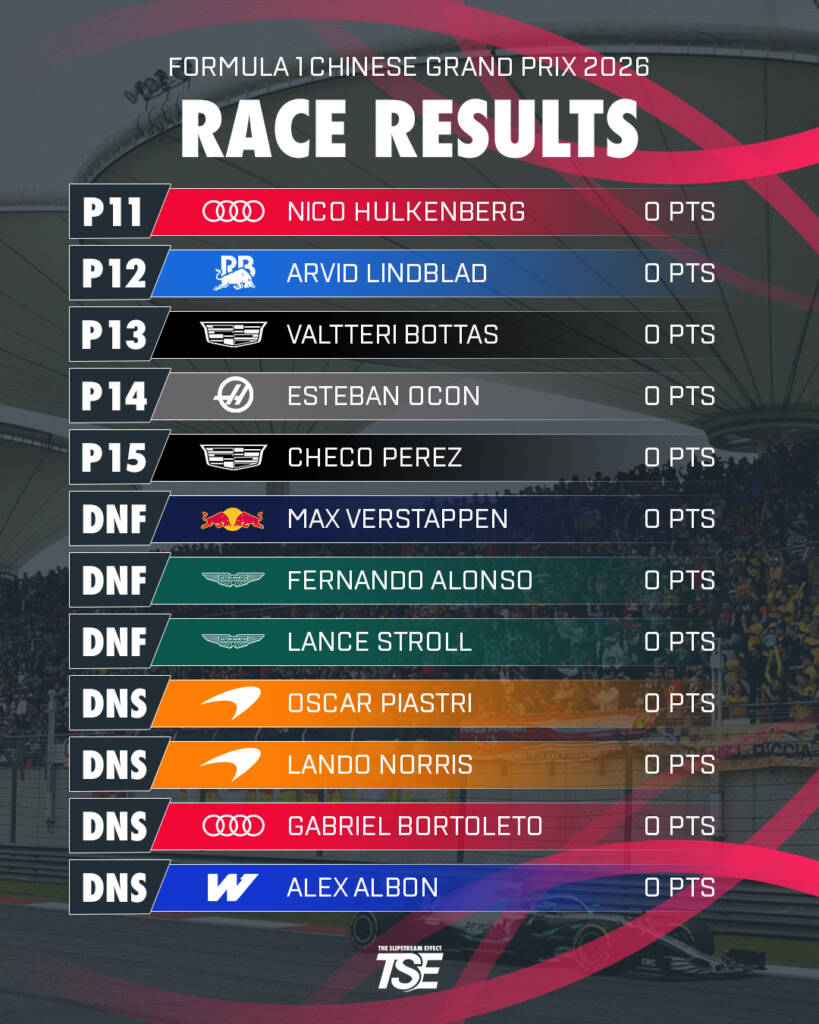
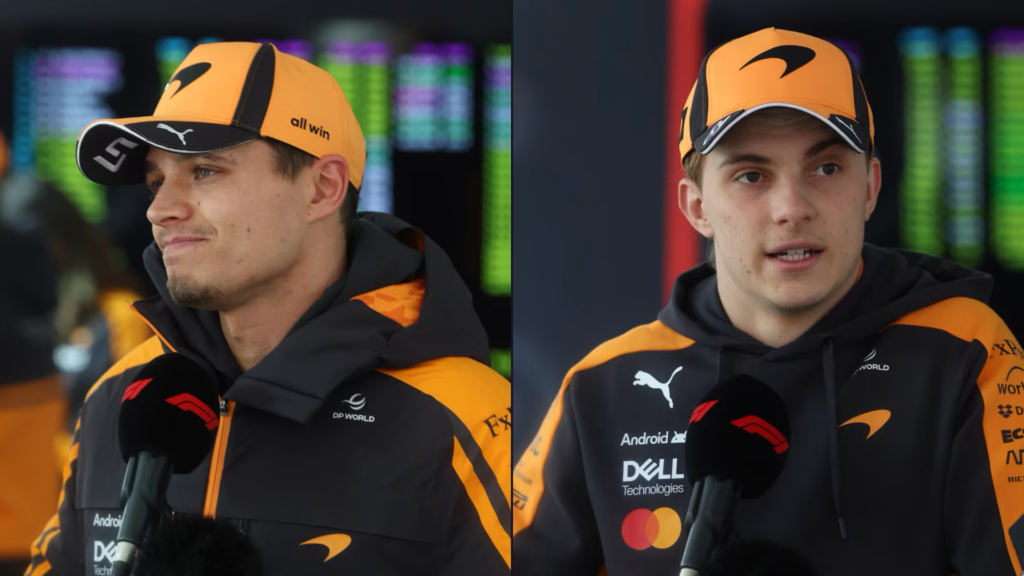
The story of Shanghai was not only about the four cars at the front. Before the formation lap had even settled the field, the race had already been disrupted by a remarkable set of non-starters. Both McLarens failed to make the start, with separate electrical issues sidelining Norris and Piastri in a disastrous afternoon for the team. Gabriel Bortoleto also failed to start, while Alex Albon’s Williams was ruled out before lights out as well.
That changed the shape of the midfield immediately. With McLaren removed from the equation before the first lap and reliability becoming a theme elsewhere too, points were suddenly available deeper into the order than they might otherwise have been. The Grand Prix became an opportunity race, and several drivers made the most of it.
Bearman, Gasly and the midfield step up
Ollie Bearman continued one of the strongest starts to the season outside the top teams by finishing fifth for Haas. After his points in Australia and a solid Sprint weekend in China, he now looks like one of the standout performers of the early campaign. His result was not built on chaos alone either. Haas had shown credible pace throughout the weekend, and Bearman executed the race well when the opportunities opened up.
Pierre Gasly also delivered a strong result in sixth for Alpine, backing up a points finish in Melbourne with a more complete and convincing performance in Shanghai. He had already qualified well, putting Alpine at the front of the midfield, and he converted that position into a clean points finish in a race that demanded tyre management and discipline.
Liam Lawson added more points for Racing Bulls in seventh, while Isack Hadjar recovered from an early spin and an opening-lap pit stop to finish eighth and score his first Red Bull points. Carlos Sainz brought Williams home in ninth, which will matter for a team that has looked short on both pace and reliability so far. Franco Colapinto completed the top 10, scoring his first point as an Alpine driver after recovering from contact and a messy race around him.
Red Bull and Aston Martin leave with bigger concerns
If Mercedes leave China looking like the benchmark and Ferrari leave knowing they are close enough to fight, Red Bull leave with much more serious questions. Verstappen’s weekend never really recovered from a difficult qualifying and poor Sprint, and his race ended in retirement after an apparent technical issue. He had already struggled off the line again, and the car looked disconnected from the kind of authority usually associated with Red Bull at its best.
Hadjar’s recovery to eighth gives the team something to take away, but the overall picture remains uncomfortable. Through the Sprint and Grand Prix combined, Red Bull came away with very little, and their problems do not look limited to a single weak session or one compromised setup. Reliability and balance both appear to be part of the issue.
Aston Martin’s situation was similarly bleak. Stroll’s stoppage triggered the Safety Car, and Alonso also retired later in the race, meaning both cars failed to finish. Across two rounds, the team has already had too many reliability questions and not enough pace to offset them.
The Chinese GP leaves Mercedes in front, but changes the conversation
The most important conclusion from China is not simply that Mercedes are fast. It is that their strongest asset right now may be having two drivers capable of turning that speed into major results. Russell remains the championship leader, thanks in part to his Sprint win, but Antonelli’s victory means the balance inside the team has shifted almost instantly.
That does not mean the hierarchy has disappeared altogether. Russell is still one of the most complete drivers on the grid and was strong again in Shanghai. But Antonelli has now shown he can convert pole into victory, recover from a compromised start, manage a strategic race, and handle the pressure of a closing first win. That is more than a promising rookie result. It is the profile of a driver who can shape a season.
Japan will now arrive with a very different feeling. Mercedes head there as favourites, Ferrari know they are close but not yet close enough, and McLaren need to recover from a nightmare weekend that never really began. But the biggest shift is internal. After only two rounds, Mercedes already have the sort of problem every team says it wants: two drivers in form, one dominant car, and no easy way to frame one as supporting cast.
That is why Antonelli’s win matters beyond the milestone. Shanghai did not just produce a first-time Grand Prix winner. It introduced the possibility that Mercedes’ biggest fight this season may come from within.

1 Comment