Every year, the paddock arrives at Monza carrying a story about who’s untouchable. There’s always a team, a concept, a car that looks inevitable, the one everyone else has quietly accepted they can’t beat. Almost every era has produced a version of that machine. The MP4/4. The F2004. The W11. The RB19. Cars that bend the season around themselves. Monza is where those machines have historically come undone.
Not always in the standings, and not always in the final result, but in the illusion of invulnerability. Monza is the circuit that exposes the blind spots dominant teams don’t have to confront anywhere else. It’s the place where engineering perfection meets a geometry that refuses to cooperate.
The place where certainty falters
The pattern goes back decades. In 1988, McLaren arrived with a car so superior it made the rest of the grid look like a lower category. They won every race that year. Except for Monza. The reasons were circumstantial, chaotic, and emotional, but the outcome told an ongoing story: the perfect season cracked here. The strongest car of its era found the one venue where pure dominance couldn’t insulate it from the sport’s unpredictability.
That’s the first lesson Monza teaches: dominance is contextual. A car can be unbeatable in the environment it was designed for, yet mortal in the one environment that refuses to accommodate its strengths.
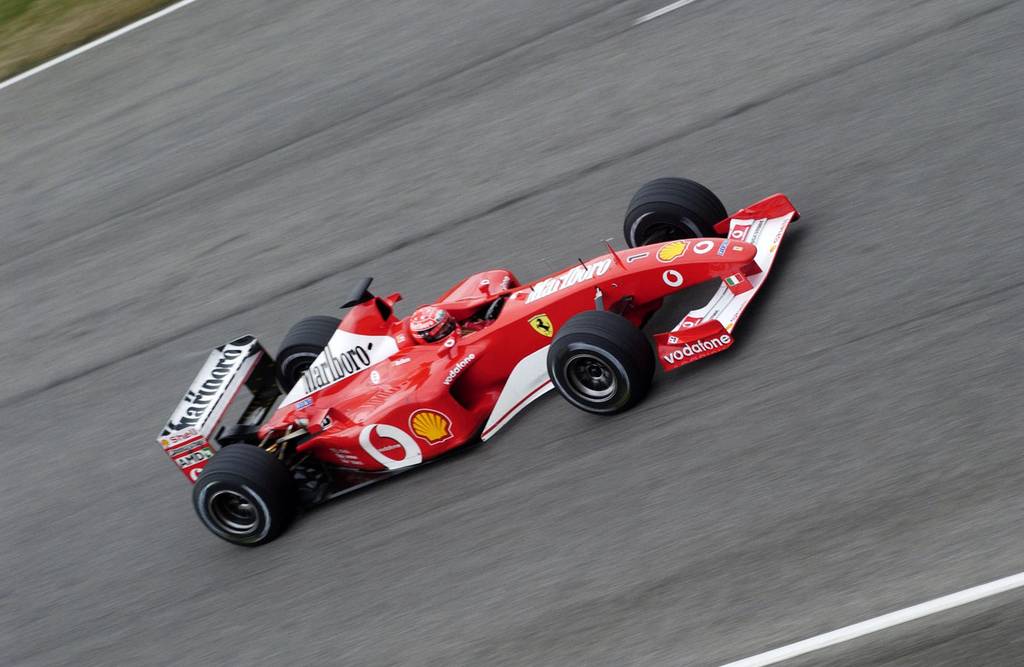
The second lesson came in the early 2000s. Ferrari’s empire was built on technical excellence and operational precision. The F2002 and F2004 were precision instruments. But Monza forced them to compromise, stripping away the deep layers of downforce and cornering stability that made them look unassailable everywhere else. They still took victories, but they had to fight for them on raw engine power and razor-thin margins rather than effortless aero superiority. Monza doesn’t need to defeat a dominant team to weaken it. It just needs to show the rest of the grid that the leader can bleed.
The hybrid era repeated the pattern. Mercedes built cars so efficient, coherent, and relentlessly optimized that the sport assumed their supremacy was structural. But Monza found the edges. The W06 struggled with braking stability into the chicanes. The W09 fought drag sensitivity down the endless straights. Even the W11, an extremely competitive car in the modern era, looked less inevitable here. The team still won, but the weekend served as a strategic negotiation as opposed to a direct, quick win. Monza reveals the elements that were never truly dominant.
That is the heart of its narrative: Monza forces top-tier cars to confront the parts of their design philosophy that do not scale. Every great car is built around a core idea: aerodynamic load, platform stability, energy efficiency, or mechanical compliance. Monza strips away everything except that core concept. If the idea is fragile, the car becomes fragile. If the idea is narrow, the car becomes narrow. If the idea is conditional, the car becomes conditional.
The Circuit That Reveals the Idea Behind the Car
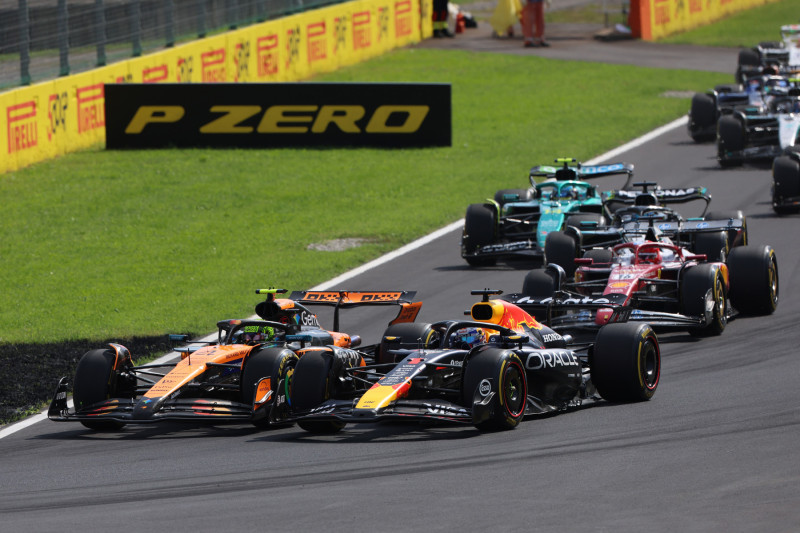
Today’s machinery is designed for complexity: high-downforce platforms, intricate aerodynamic surfaces, and finely tuned energy management. Monza, by contrast, is an ultra-low-downforce, slipstream-distorted environment that brutally punishes drag inefficiency.
Red Bull’s recent supremacy followed the same pattern. The RB18 and RB19 were exceptional, being efficient, stable, and predictable. But Monza exposed the limits of their setup window when forced into extreme, low-drag trim. The cars remained formidable, but they were no longer inevitable and they became beatable in ways they simply weren’t elsewhere. The gaps shrank and the margins tightened. Team narrative doesn’t impact a team’s success at Monza, architecture does.
That is why this weekend matters. Not merely because it is fast, and not just because it is historic, but because it serves as the annual stress test of supremacy. It is the venue where the strongest car learns whether its dominance is structural or circumstantial. It’s a track where historically the paddock discovers whether the lead team has built a concept that survives exposure or one that thrives only in environments that flatter it.
By Sunday night, the paddock leaves with an altered understanding of the championship. Not a reversal, and not a total shock, but a recalibration. The dominant car remains dominant, but no longer mythical. The competitive order may not have shifted entirely, but the psychological order has. Monza buries the idea that champions are inevitable.
Further track analyses are available under the circuit profile tag.