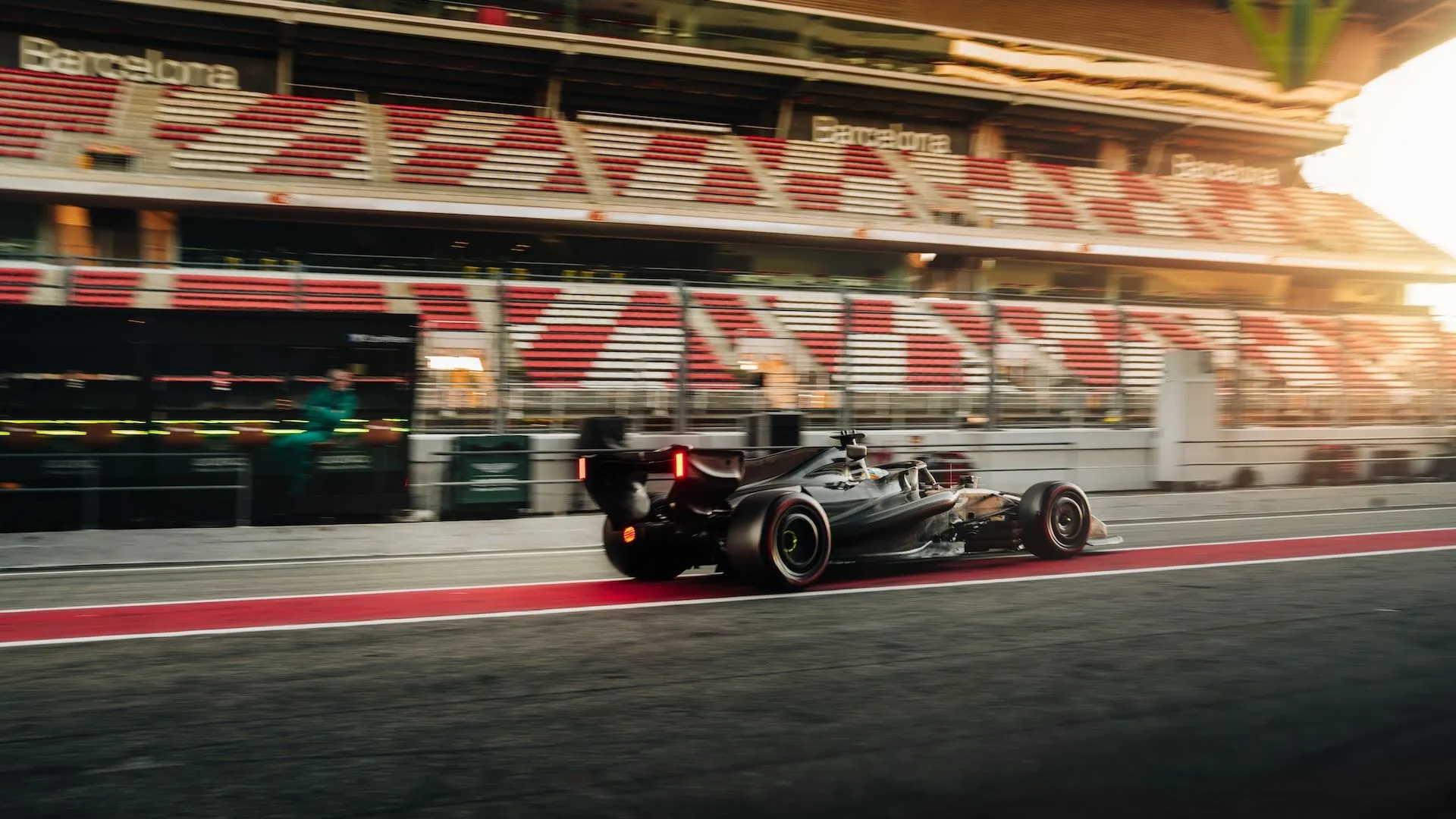
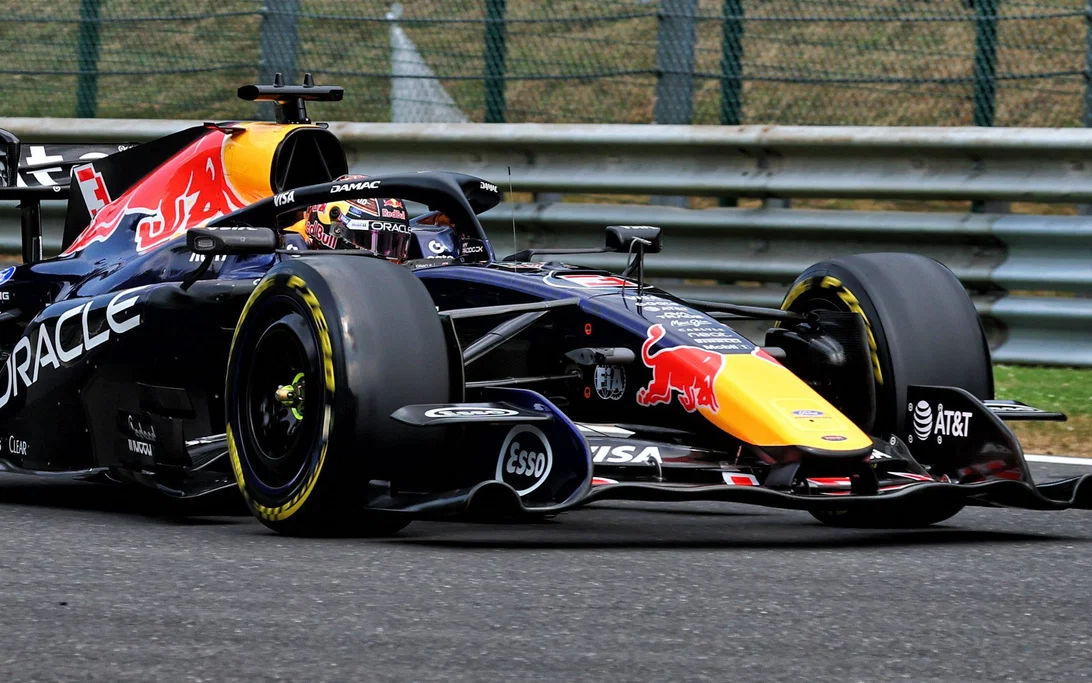
The road climbs, tips over the crest of the Raidillon and the car goes light. That hill has been part of Spa-Francorchamps since 1939. Every generation of grand prix driver took the same ascent, leaving a line in the asphalt for the next to follow.
Between 2022 and 2025, the drivers of ground-effect cars reached the top at close to 300km/h, held to the track by an aerodynamic load on a scale the sport had never known. Brian Redman, a Spa specialist of the 1960s and 1970s, recalled that even a struggling Cooper-BRM from the late 1960s was flat over the same crest at roughly 130mph.
The corner barely changed between those two eras, but almost everything between the driver and the asphalt did. This feature follows that change from the instinctive sliding of vintage racing to the heavy, stiff and ferociously quick machines that were forced through the same old corners and narrow streets until the rules reset in 2026.
When the driver was the only downforce
Spa was both adored and feared long before downforce existed. Eau Rouge began life in the 1920s as the sharp left-hander that sent drivers towards a hairpin near the German border, and the Raidillon was cut in 1939 to bypass the slow Ancienne Douance hairpin and made the road circuit faster.
Chris Amon, Phil Hill and Tony Brooks were among the drivers who loved the place, while the journalist Denis Jenkinson considered it a sterner test than even the Nordschleife. Through the 1.5 literacy years from 1961 to 1939, Nigel Roebuck has written, downforce was not yet a thing.
Therefore, cornering speed depended far more on a driver’s delicate skill. That is why Jim Clark and Stirling Moss could show their genius on circuits like Spa, where the car’s limit was something to be felt through the steering wheel and the seat rather than a read from a sensor.
The first real aerodynamic aid arrived in 1968, when Chris Amon turned up at Spa with a small rear wing on his Ferrari and took pole by four seconds. Until then, the Raidillon was a conversation between hands, seat and road. The low-slung cars threw sparks as they bottomed out in the compression at the foot of the hill, and an unforgiving stone wall lined the outside of the bend all the way up to the crest.
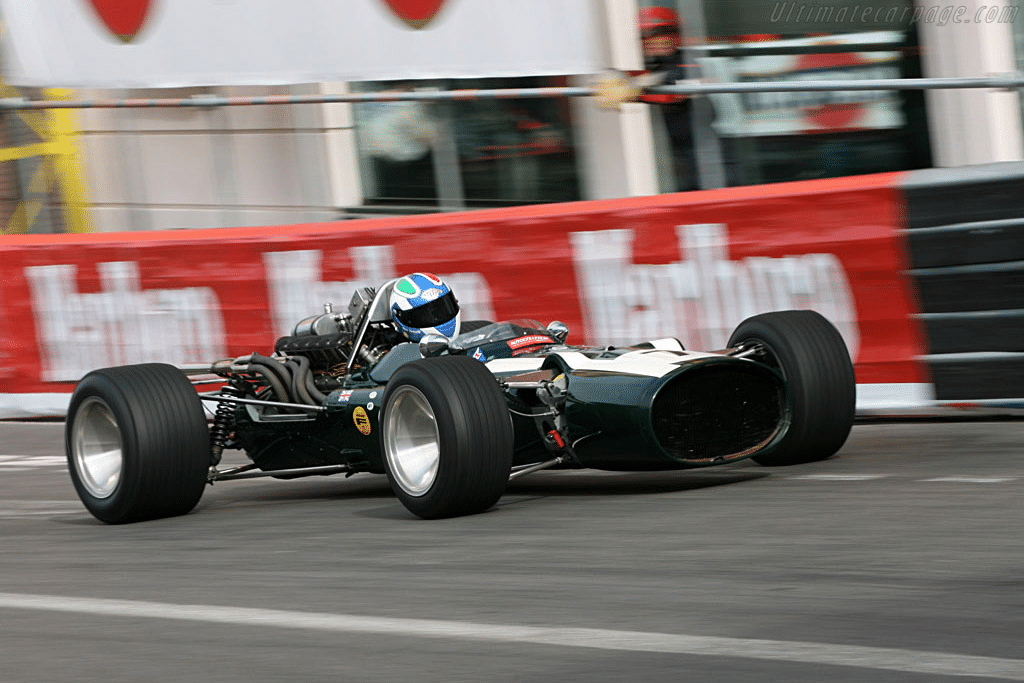
Redman remembered that a late-1960s Cooper-BRM, hardly a front-runner, still took the Eau Rouge and Raidillon complex at about 130 mph and reached Les Combes at around 160 mph. Those speeds were earned by placing the car through a series of small slides, correcting each one in an instant, and trusting narrow tyres to hold on a surface that offered very little forgiveness.
The same corner shows how seriously the drivers took the risk. Jackie Stewart’s heavy crash at Spa in 1966, which left him trapped in a fuel-soaked BRM, helped turn him into the sport’s most persistent safety campaigner. By 1969, the Grand Prix Drivers’ Association had grown so concerned about rising speeds, dangerous road surfaces and inadequate barriers that the Belgian Grand Prix was cancelled.
The race returned in 1970 with Armco lining the hill, which was the first step towards the circuit Redman later described as producing excellent racing in enviable safety. It would be wrong to call the vintage drivers simply braver, because they were working with almost no margin and their skill was the only safety system the cars had.
How ground-effect cars rewrote Eau Rouge
Ground-effect cars changed the nature of the question. Their floors carry tunnels that accelerate the air underneath and pull the car towards the road, which is why the 2022 generation could carry so much speed through high-speed corners. Eau Rouge had already become a flat-out corner for most of the modern era, and Lewis Hamilton has described the feeling at the bottom of the hill as the moment when your insides drop.
The task was no longer to find the limit by feel. It was to keep a stiff, heavy, aerodynamically sensitive platform calm while enormous loads came and went.
The price of grip in ground-effect cars was weight and stiffness. The 2022 cars carried a 798 kg minimum weight, the heaviest in F1 history and up from 752 kg the year before. The new 18-inch wheels had thinner sidewalls than the 13-inch tyres they replaced.
Teams ran the cars low and stiff to keep the floor working, which left less suspension travel to soak up bumps. On the opening day of pre-season testing in Barcelona, Lando Norris said the extra mass made the car feel a bit more sluggish. Mick Schumacher agreed that the weight was the first thing he noticed. Norris added that he could feel the weight most under braking.
FIA technical chief Pat Symonds summed up the trade-off before the 2023 season by saying that the cars would always be faster in fast corners and slower in slow corners. That is why Spa suited ground-effect cars so well and why the tight streets of Monaco suited them so badly.
The physical cost was real as well. At the 2022 Azerbaijan Grand Prix, Hamilton struggled to climb out of his Mercedes after a race in which the car bounced violently along the long straight. Afterwards, he said he had been praying for it to end. He still finished fourth, and floors were raised by 15 mm for 2023 to curb the bouncing.
The drivers of ground-effect cars had absorbed a punishing new reality and kept racing through it, which was a measure of their toughness as much as the cars’ demands.
Wide cars on streets that never grew
Monaco showed the squeeze most clearly in 2022. Twenty years earlier, F1 cars were about 4.5 meters long and 1.8 meters wide. It was already tough for two to run side by side through the principality.
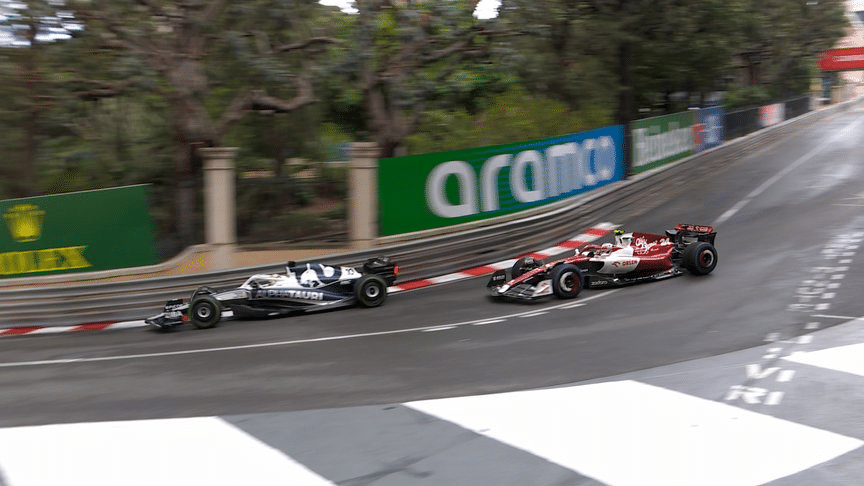
Ground-effect cars were two meters wide on a track that, as Hamilton pointed out, had stayed the same width forever. Pierre Gasly said overtaking would be nearly impossible, and Kevin Magnussen predicted the circuit would feel smaller than ever. Their concerns rested on simple arithmetic, because every extra centimeter of car meant less room for the small corrections drivers rely on at the limit.
The way the cars felt over the bumps made that squeeze even harder to manage. Max Verstappen said he could feel the weight and that the stiff set-up made these ground-effect cars bumpier too. He added that the bigger wheels and tyres reduced what drivers could see.
Esteban Ocon expected the taller sidewalls to hurt vision in the same way. Sebastian Vettel joked in Bahrain that a city tour bus would prepare a driver for Monaco better than a simulator. Hamilton, who remembered earlier visits in lighter and more nimble cars, said it felt as if his eyeballs were coming out of their sockets on the bumps.
Verstappen was among a significant number of drivers who locked up in the braking zone on the uneven surface as they learned the new limits.
Mercedes had a hard Friday, and Hamilton pointed to the stiff set-up as the cause. He said the 2022 car had to be set up so stiff for the aero to work that it was hard to find the limit over Monaco’s bumps, and George Russell agreed that the stiffer cars made a lap harder to build.
Ferrari, meanwhile, took to the same surface well, with Charles Leclerc leading the second Friday session. Hamilton noted that Ferrari’s strength over kerbs, already visible at Imola, was playing to them again. The comparison showed how much the behaviour of ground-effect cars over bumps could decide a weekend at a track where the walls offer no second chances.
Zandvoort’s banking tests ground-effect cars
Zandvoort asked a very different question. F1 had raced there since the 1950s before leaving after 1985, and it returned in 2021 after 35 years away. The season circuit saw its last race in 2026 won by Norris. It had banking of around 18 to 19 degrees at Turns 3 and 14, roughly double the nine degrees of the Indianapolis Motor Speedway.
The late Charlie Whiting, a former FIA race director, suggested the banking after simulations showed drivers suffering virtual spins. It lets them carry far more speed through those corners. The circuit also runs alongside the coast, where onshore wind can upset the cars and cover the track in sand. Its narrow layout leaves little room to recover from a mistake.
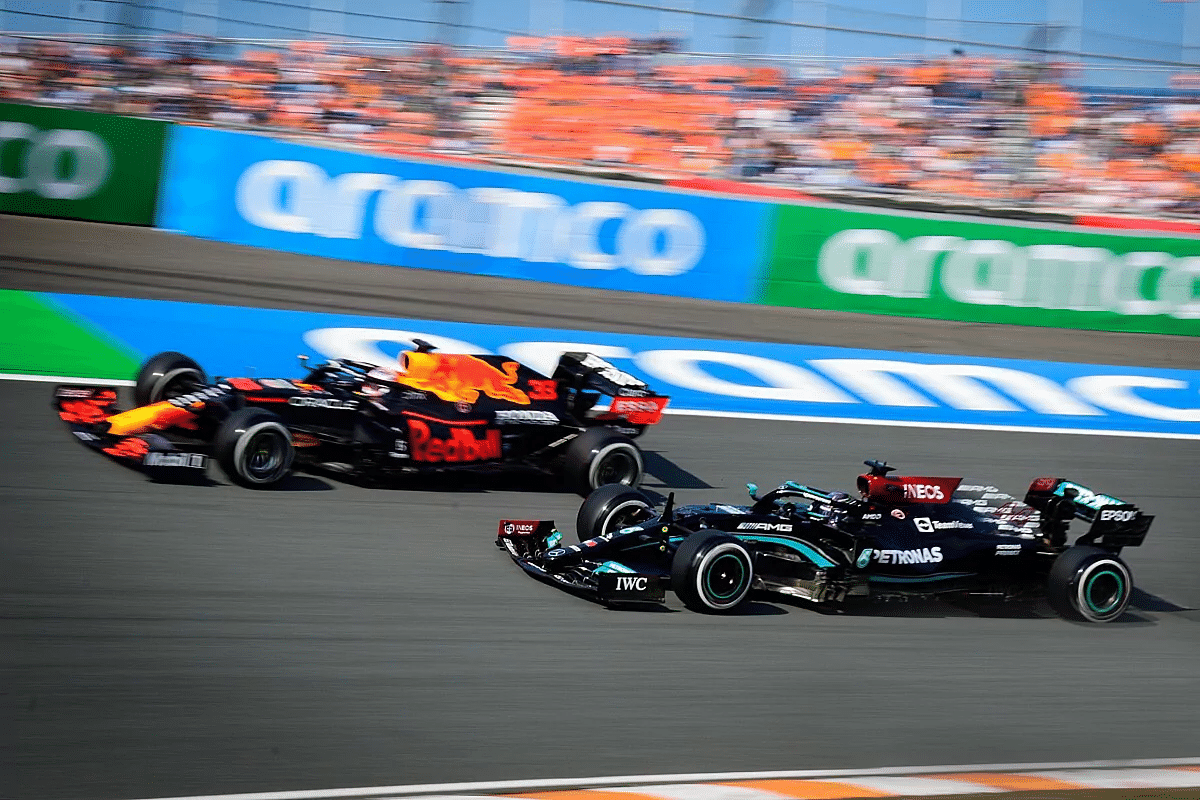
Ahead of that 2021 return, Verstappen warned that F1 cars were not made for that inclination, with the floor and front wing at risk of touching and the car wanting to pull itself down. Ground-effect cars made that concern more pressing, because they are happiest at a steady ride height and every meter of banking changes how the floor meets the tarmac.
Pirelli noted that the banked corners place sustained combined forces on the car, with downforce and lateral load arriving together. Zandvoort also needs much more downforce than Spa, as Alex Albon said before the 2022 race. He called it a very narrow track with little room for error.
Braking into Turns 1 and 11 is around 5g and Turn 7 asks for roughly 5g laterally, so the drivers are loaded from every direction.
In that sense, Zandvoort showed ground-effect cars at their most demanding. Drivers had to commit to the banking and trust the aero to hold the car up, which meant long stretches under combined downforce and lateral load.
The corner names carry the circuit’s own history, with Turn 3 honouring former circuit director John Hugenholtz and Turn 14 named after Arie Luyendyk, a two-time Indianapolis 500 winner.
That link to an oval is apt, because the banking turns a corner into something closer to a speedway, taken at much higher speed by cars built for road courses.
What the ghosts leave for 2026
The ground-effect era ended after 2025. The 2026 cars dropped the Venturi tunnels that defined ground-effect cars. They fell to a 768 kg minimum weight and shrank to 1.9 meters wide on a 3.4 meter wheelbase. The aim was to make racing easier on tight circuits like Monaco.
Drivers have called them more nimble than the 2025 cars, and active aerodynamics have replaced DRS, although the FIA does not allow moveable wings through Eau Rouge and Raidillon itself.
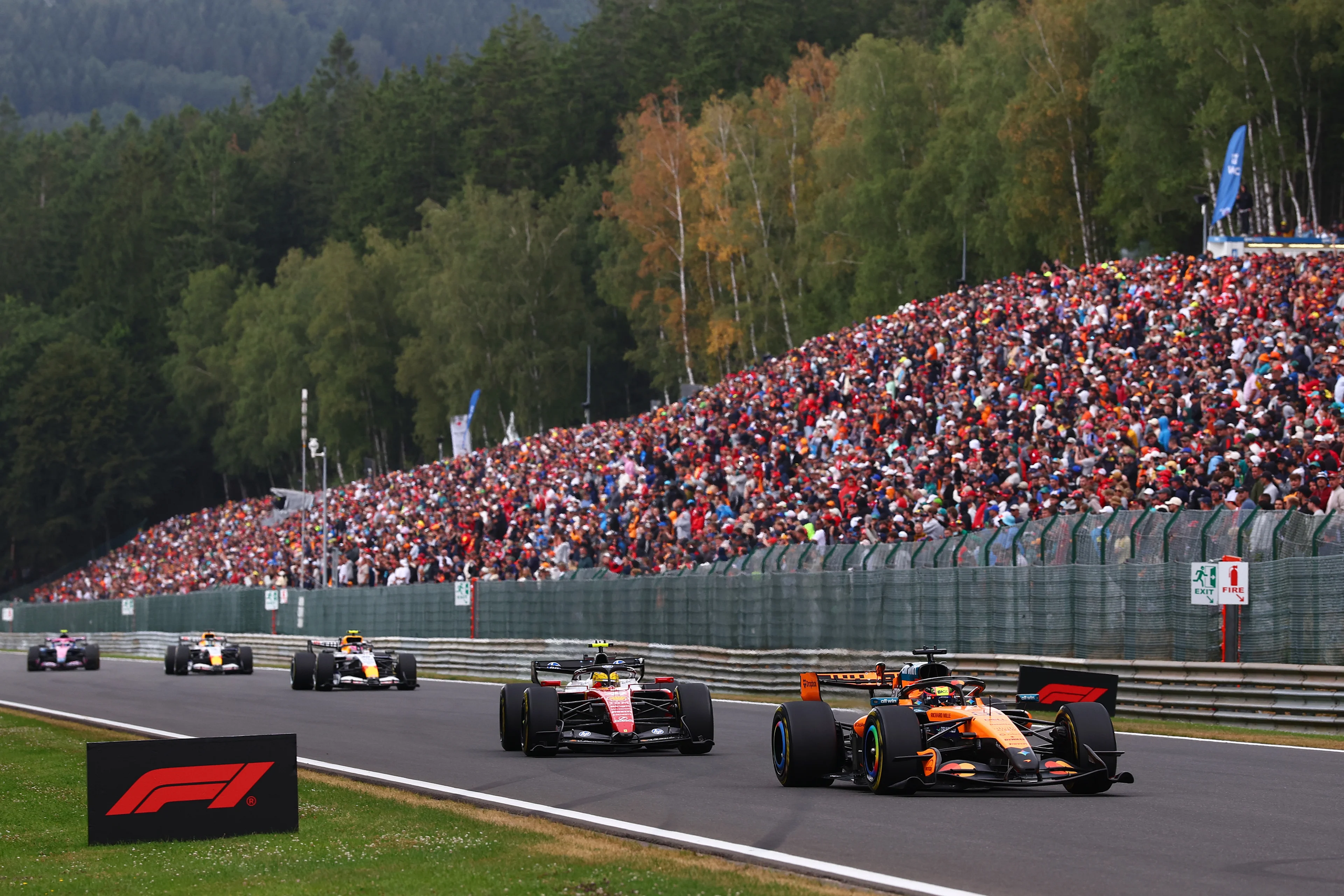
The numbers show how high the ground-effect cars set the bar. At the 2026 Belgian Grand Prix, Kimi Antonelli’s fastest qualifying lap was about two seconds slower than the equivalent lap in 2025. The race laps were around four seconds slower, with Antonelli downshifting through Raidillon for much of the race.
Monaco told a similar story that June, when Lance Stroll said Aston Martin was five to six seconds off the pace of the ground-effect cars while some rivals were only about a second slower. Those comparisons say nothing negative about the new cars, which were designed with different goals.
However, they do say a lot about what the previous generation achieved in a short time, with lap times that the sport’s next chapter has yet to match. A century after the Belgian Grand Prix first came to Spa in 1924, the same hill was being asked a news question by machines that had little in common with either of the eras that came before.
For the drivers, the lesson from every era is the same, because the old corners reward whoever adapts quickest. Clark and Moss adapted to cars without downforce, and the drivers of ground-effect cars adapted to weight, stiffness and walls that never moved.
The 2026 cars will teach the same lesson in a new language, with less load and more electrical management to balance on every lap. What remains unanswered is how fast the sport’s latest machines can eventually go through the hill that has tested every generation.
The ghosts are still on the racing line, and the next drivers will find them there.