


F1 2026 rule changes introduced by the FIA aim to address growing concerns over energy management and on-track safety.
Announced after a sequence of virtual meetings throughout April, these F1 2026 rule changes involve team principals, power unit manufacturers and drivers, and focus on four key areas, qualifying, race management, starts and wet-weather racing. With the exception of start procedures, which will still be tested, the new rules will come into effect from the Miami Grand Prix on 3 May.
Overall, the objective is to reduce excessive energy saving, improve consistency and allow drivers to push closer to the limit, while maintaining the increase in overtaking seen under the current regulations.
Why the FIA introduced changes to F1 2026 regulations
The 2026 regulations marked a major shift in Formula 1’s technical philosophy, with hybrid systems now accounting for nearly 50 per cent of total power output. While designed to modernise the sport, the changes have created unintended consequences.
Drivers have increasingly criticised the need to manage battery usage, even during qualifying laps, leading to what some have described as artificial racing.
Concerns intensified following a heavy crash between Oliver Bearman and Franco Colapinto at the Japanese Grand Prix, where a significant speed difference, partly caused by energy deployment, resulted in a 50G impact.
This incident accelerated discussions that were already planned for this stage of the season.
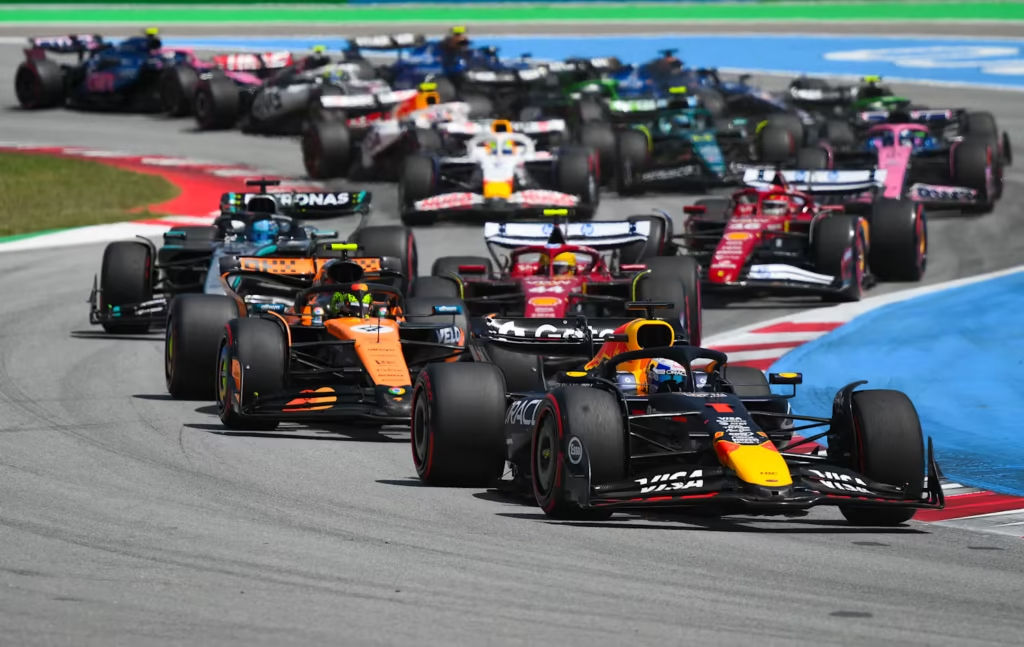
F1 2026 rule changes in qualifying
To reduce lift-and-coast scenarios during flying laps, the FIA has lowered maximum energy deployment from 8 MJ to 7 MJ.
At the same time, superclipping power, when the car harvests energy while the driver remains on throttle, increases from 250 kW to 350 kW. The aim is to improve energy recovery and reduce compromise during qualifying laps. This change also applies to races.
How F1 2026 rule changes affect races
As part of the F1 2026 rule changes, energy management during races will also be adjusted. Boost mode is now capped at 150 kW, reducing sudden and potentially dangerous speed differences between cars.
Additionally, the use of the MGU-K will be limited outside primary acceleration zones. This helps maintain overtaking opportunities while reducing unpredictable closing speeds.
F1 2026 rule changes to race starts
One of the most innovative updates involves race starts.
The FIA has developed a system capable of detecting abnormally low acceleration immediately after clutch release. If triggered, the MGU-K will automatically deploy to ensure a minimum level of acceleration, reducing the risk of slow or stationary cars on the grid.
The system is designed to improve safety without offering a sporting advantage, and will be supported by enhanced rear and side lighting to alert other drivers.
This follows incidents such as Liam Lawson’s near miss at the start in Australia.
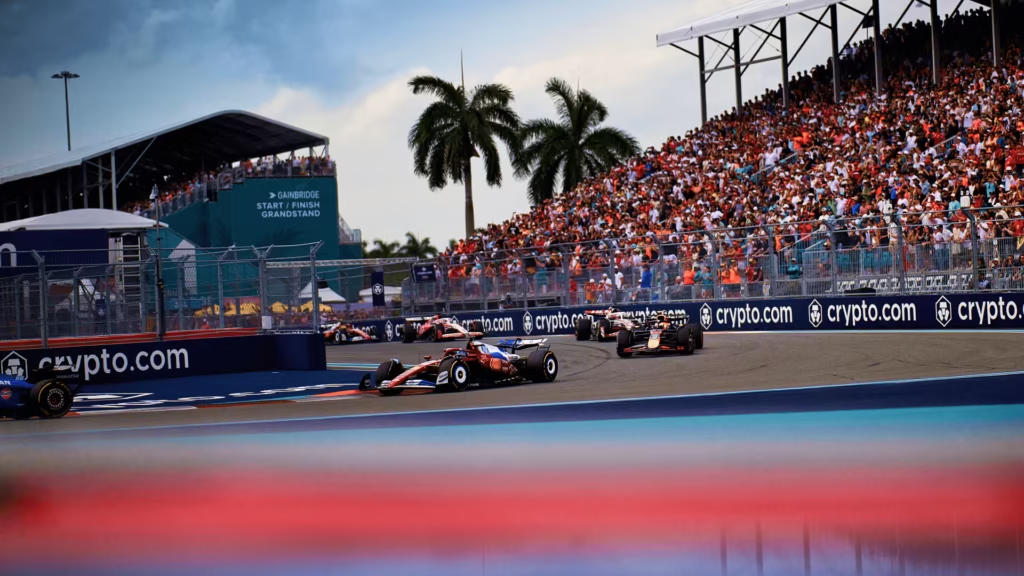
F1 2026 rule changes in wet conditions
For wet conditions, the FIA will simplify rear light systems to improve visibility and reduce energy recovery demands.
Tyre blanket temperatures for intermediate tyres will also be increased, aiming to provide better grip in low-traction conditions.
A balance between technology and racing
Despite an increase in overtaking compared to 2025, the 2026 regulations have highlighted a delicate balance between technological progress and racing quality.
The FIA’s response suggests a willingness to adapt quickly, refining rather than reversing the new era of Formula 1.
With the Miami Grand Prix marking the return, the F1 2026 rule changes will be tested immediately after recent cancellationss, including Bahrain and Saudi Arabia, the updated rules will be tested immediately.
The key question remains whether these changes will allow drivers to push more freely or simply redefine how energy is managed in modern Formula 1.
Conclusion
The F1 2026 rule changes represent an important step in refining the sport’s new hybrid era. While the regulations are still evolving, the FIA’s adjustments show a clear intention to balance innovation with better racing conditions for drivers and fans.

2 Comments