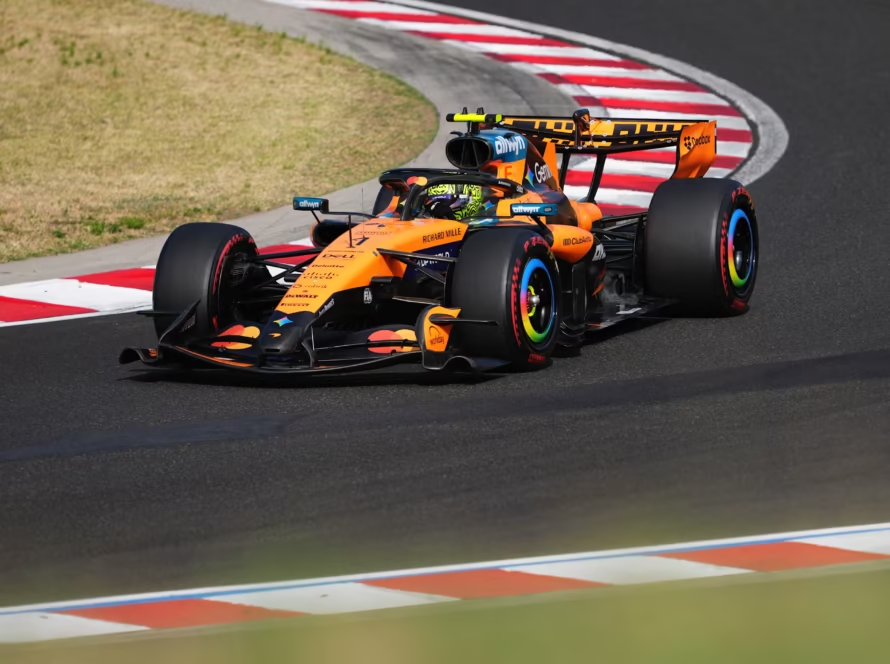
Spa‑Francorchamps began as a circuit defined by the terrain rather than human engineering. Built in 1921, the original design of the track was formed by connecting the public roads of three towns, creating a triangular track. At 14.982km, the historical version of Spa‑Francorchamps was characterised by minimal turns and dangerously fast straights. Elevation changes, blind crests, and sweeping bends were simply part of the Ardennes road network, and early racing accepted them without modification.
This origin matters. It meant Spa’s earliest identity was shaped almost entirely by geography. Drivers raced through villages and forests at speeds that quickly exceeded the norms of the era. The land dictated the risks, and the governing bodies of the time had little influence over the conditions. Spa‑Francorchamps became a proving ground because the terrain made it unavoidable.
Speed outpacing governance
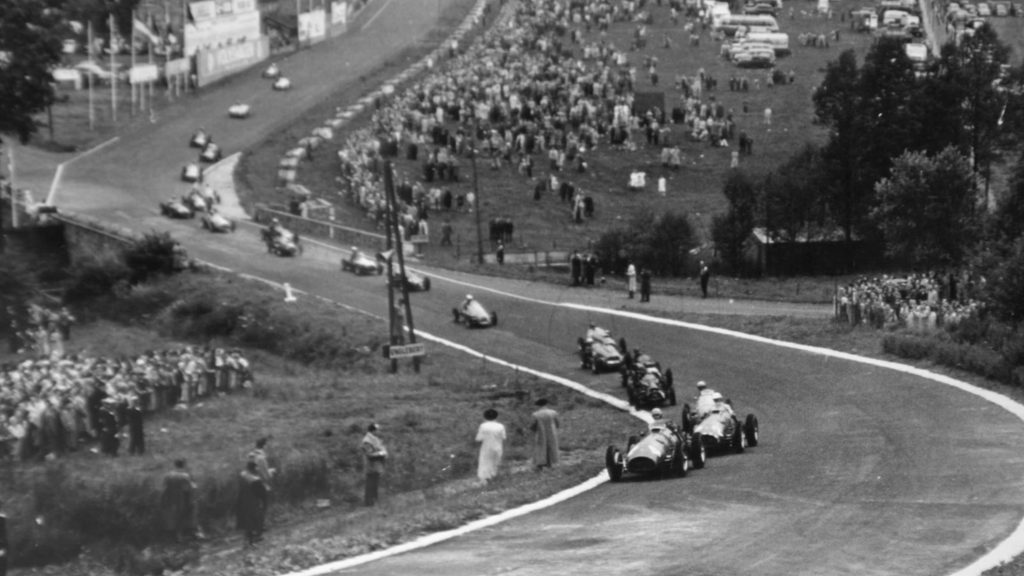
By the 1930s and 40s, machinery had evolved faster than regulation. Spa’s geometry remained unchanged, but cars became dramatically quicker. Eau Rouge (Turn 2) and Raidillon (Turns 3–4) developed their reputation as a continuous compression‑and‑climb sequence that demanded absolute commitment. Drivers experience it as one movement, even though the modern map breaks it into multiple turns.
Burnenville and the Masta straight belonged to the original fourteen‑kilometre road circuit. They were removed entirely during the 1979–1983 reconstruction; their absence reflects a layout that no longer exists. Burnenville’s sweeping arc and Masta’s narrow, high‑speed straight became symbols of a period when speed outpaced governance. The circuit’s danger was raw and fully documented. Weather variability created asymmetric conditions across the lap. Roadside buildings and telegraph poles sat metres from racing lines. Drivers spoke openly about fear, and several high‑profile incidents intensified scrutiny.
By the 1960s, Spa‑Francorchamps had become a battleground between tradition and safety. The tension reached its peak in 1969, when Formula 1 drivers collectively refused to race at Spa. The Belgian organizers had attempted to install new safety barriers, but the work was incomplete and inconsistent, leaving long stretches of the circuit unprotected.
Jackie Stewart, Jochen Rindt, Graham Hill, and others argued that Spa’s danger was no longer a matter of bravery but of unacceptable risk. Their unified boycott forced the cancellation of the Belgian Grand Prix and made it clear that Spa could not continue in its existing form. It was the moment when the sport’s governing bodies were compelled to confront the limits of tradition and acknowledge that Spa’s geography could no longer be managed without fundamental change.
Redesign under necessity
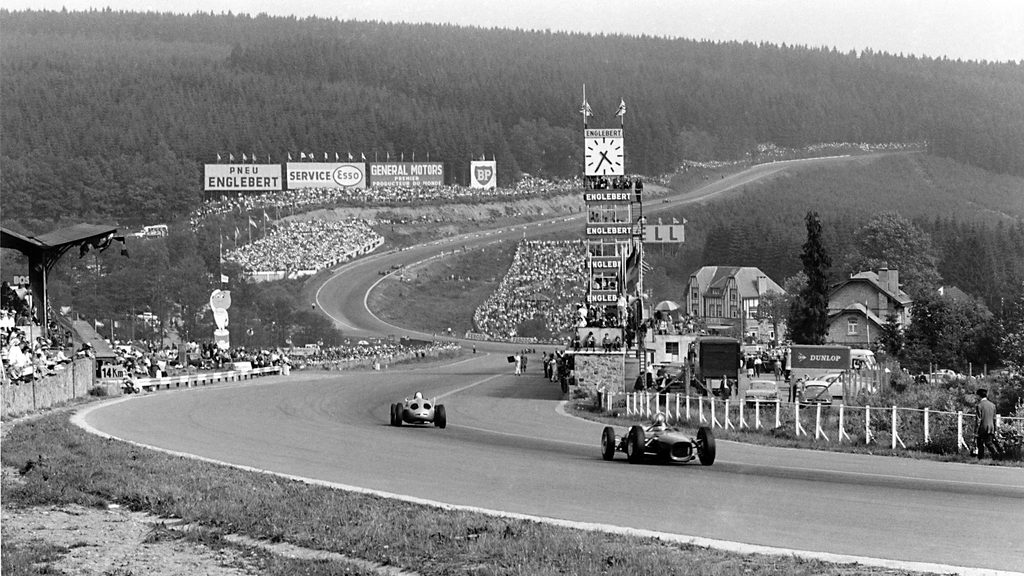
The redesign implemented between 1979 and 1983 marked the first time governance truly asserted control over Spa‑Francorchamps. The fourteen‑kilometre road circuit was shortened to just over seven kilometres, removing Burnenville, Masta, and other sections that had become incompatible with modern safety standards.
This reconstruction was a structural shift in the circuit’s identity. The new layout preserved the Ardennes’ elevation and flow but introduced engineered safety features: runoff areas, revised corner profiles, and controlled braking zones. Eau Rouge (Turn 2) and Raidillon (Turns 3–4) were reworked to meet contemporary expectations while retaining their defining characteristics. The Bus Stop chicane (Turns 18–19) added a regulated end to the lap.
For the first time, Spa‑Francorchamps became a circuit shaped equally by geography and governance. The land still mattered, but regulation finally had the authority to reshape it.
Modern Spa-Francorchamps: A circuit still negotiating with its past
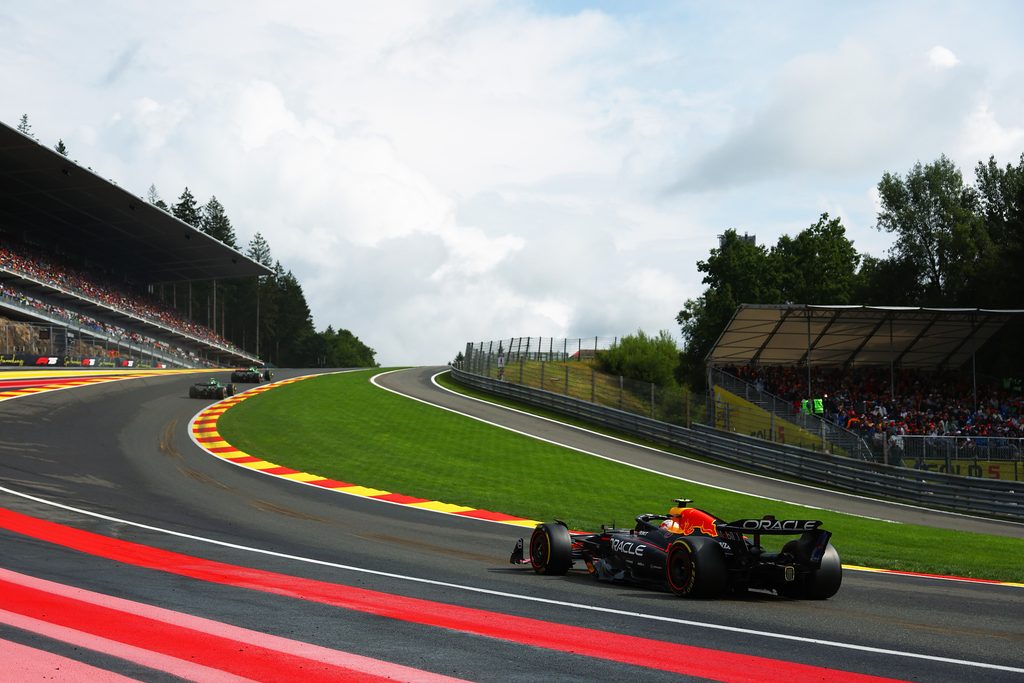
Even after its radical safety reconstruction, Spa‑Francorchamps still forces drivers and engineers to confront the same physical realities that defined the old circuit. The track does not just challenge drivers; it forces engineers into a brutal, mathematical compromise.
Because the circuit is split into three distinct acts, a car cannot be set up perfectly for a whole lap. The first and third sectors, defined by the massive Kemmel and Blanchimont (Turn 17) straights, demand a low‑drag setup, where aerodynamic wings are flattened out to let the car slice through the air at maximum top speed. But the middle sector is a completely different beast. Through high‑speed, sweeping corners like Pouhon (Turns 10–11), cars require immense downward aerodynamic pressure to glue their tires to the asphalt.
If a team trims their wings to be fast on the straights, the car becomes unstable and slides through the forest sections, shredding its tires. If they dial in heavy wings for the corners, they become sitting ducks on the straights, easily overtaken. Finding the sweet spot in this compromise is a dark art that teams still struggle to master every year.
Then, there is the sky. Because the seven‑kilometre track is draped over vast valley ridges, it is large enough to create its own microclimates. It is entirely common for the tarmac to be bone‑dry and baking under sunlight at La Source (Turn 1), while a localized rain shower wets the track at the entry of Pouhon. Drivers must navigate these transitional grip levels with zero margin for error, relying on split‑second intuition rather than data on a computer screen.
2026: The latest negotiation with Spa’s terrain
The 2026 Belgian Grand Prix will be the latest high‑stakes round in this century‑old negotiation between terrain, speed, and governance. Formula 1 arrives with a new era of lighter, nimbler cars designed to slice through the air cleanly, making it much easier for drivers to tail-gate and overtake each other.
The biggest game-changer, however, is the introduction of ‘active aerodynamics’, high-tech wings that automatically shift shape on the fly to cut drag on the straights and maximise grip in the corners under strict safety limits. But even with modern machinery, Spa’s most defining forces remain unchanged.
Raidillon continues to be one of the most scrutinised sections of track in global motorsport. After the fatal Formula 2 accident in 2019 involving Anthoine Hubert, the circuit underwent significant safety work including expanded runoff, updated barriers, and adjustments to spectator zones. Further modifications were completed in 2022, including gravel traps and additional space at the top of the hill, all aimed at reducing the severity of accidents in this compression‑and‑crest sequence.
These changes reflect a simple truth: Spa’s terrain still dictates the limits. No matter how advanced the 2026 cars become, the climb out of Eau Rouge remains a place where commitment is absolute and consequences are immediate.
The rest of the lap reinforces the same tension. The long straights of Sector 1 and Sector 3 reward efficiency; the forested sweep of Sector 2 demands downforce and stability. The Ardennes weather continues to fracture the circuit into microclimates, where one sector can be dry and another soaked. Drivers still navigate these transitions with instinct rather than certainty.
Car technology evolves, regulations evolve, but the topography of the Ardennes does not. On every single lap, Spa’s wild history is still calling the shots.