The reigning world champion Lando Norris said something quite bold in Hungary. He responded to a question about George Russell’s struggles adapting to the dominance and 2026 driving style of the Mercedes car.
“I think the more experience you have in Formula 1, the better equipped you should be. If you’re not ready to adapt to a different car, then you’re not at a good enough level. It’s our job, it’s what we’ve got paid millions to do. It’s to drive any car you get given, whether it’s a good one, a bad one, an easy one or a hard one. You have to do it.” He said.
Norris did not say this lightly, or to mean in a way that Russell was a lesser driver. His response comes from a place of adapting his own driving style constantly to cars that are the complete opposite. “I mean, I’ve had to change my driving style every single year of my life. I guess for him it’s worked for 20 years, for me it’s not worked. My driving style worked back in 2018 when I did my test year. That’s probably about it. Ever since then I’ve had to change.” he told Motorsport.com
Adapting to a different driving style is never easy, and the 2026 regulation reset has made that truer than most. It goes against the muscle memory of these drivers to mould their behaviour and habits of racing these high-technology cars in a manner that’s completely different. It is a simple fact that Russell hasn’t been able to adjust to the car provided by Mercedes.
The veteran side of the split
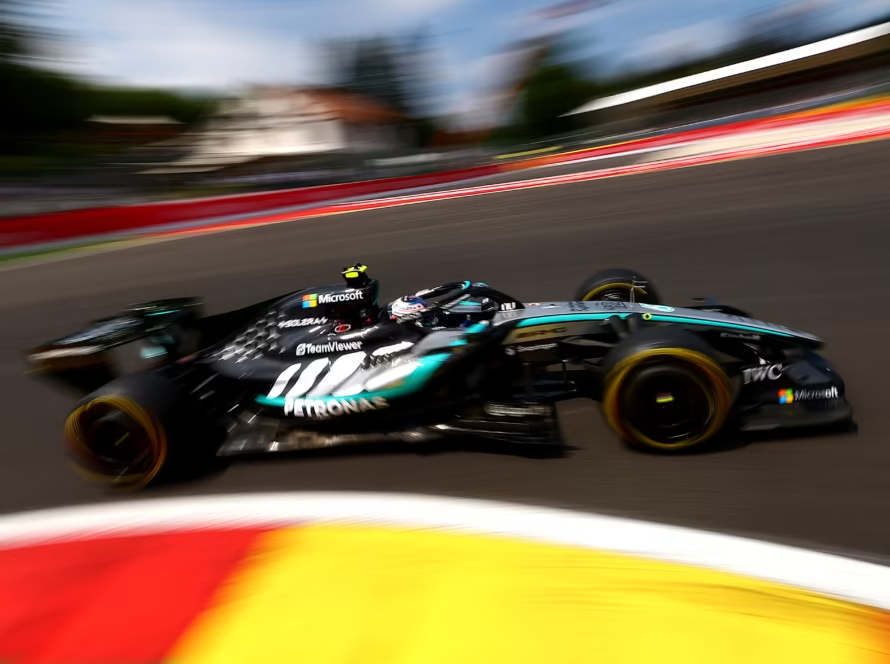
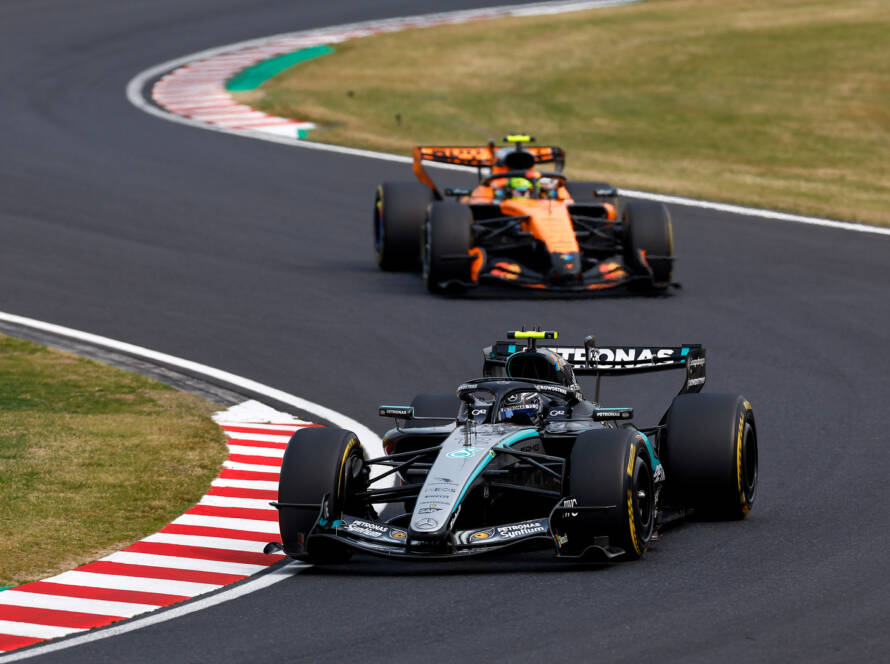
Russell’s 2026 Mercedes has been the fastest or near-fastest car on the grid. It has been on-par with his teammate, Kimi Antonelli. However, despite having the same car, Russell has trailed behind his teammate in race wins as well as the drivers’ standings. Even so, the 2026 driving style adjustment has been the harder battle.
“Every single race I come into at the minute, I feel like I have to completely forget the last weekend and learn how to drive a new car, because that’s how it is for us.” Russell said during the Hungarian Grand Prix weekend. However, he mentioned that the 2026 driving style adaptation was not a struggle that he faced alone. “Every driver is different. But for me, my whole career in F1 has been about how I can change my driving style every season.”
The young driver side
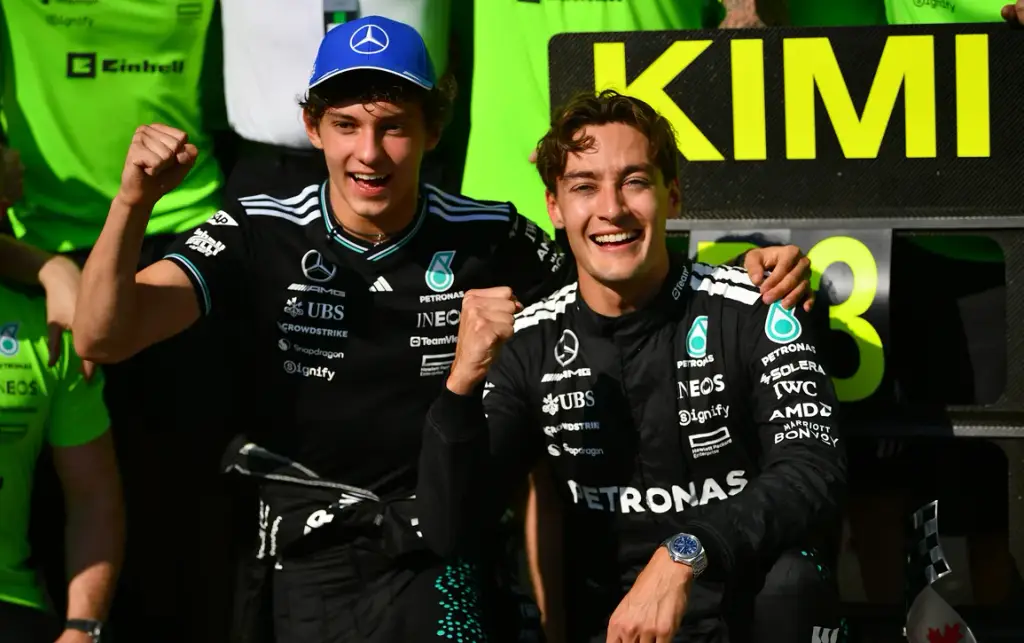
While Russell spends his weekends trying to forget the last one, the grid’s newest arrivals aren’t finding the 2026 driving style nearly as disorienting. Antonelli, still in his second full season, has out-scored his more experienced teammate through the exact regulations reset that was supposed to reward whoever adapts faster.
Give a driver a car with no precedent, and the one with the least history to unlearn comes out ahead. Teams seem to believe some version of it too, quietly recalibrating how much a decade of experience is actually worth when the regulations wipe the reference points clean.
But the younger drivers themselves aren’t confirming the story. Gabriel Bortoleto was asked directly whether 2026 splits the grid by generation, and he pushed back on the premise. “We are the 22 drivers in the world doing Formula 1,” he said, framing adaptation as the baseline job description much like Norris. He added that his own driving hasn’t been overhauled so much as fine-tuned for the 2026 driving style, small adjustments to when he pushes into a corner and when he backs off to protect energy for the next one.
If the driver supposedly benefiting from a clean slate won’t claim advantage, the generational framing might be doing more narrative work than explanatory work.
What the cars are actually asking for
It helps to be specific about what’s changed under the drivers, because ‘adapt’ is doing a lot of lifting when people talk about the 2026 driving style. The MGU-H is gone. The MGU-K is nearly doubled in power, with the combustion engine contributing up to 400kW. The electric motor contributes up to 350kW, meaning close to half the car’s performance now depends on how well a driver manages a battery rather than how hard they can lean on a chassis.
The late-braking, maximum-attack style that defined the ground-effect years between 2022 and 2025 is now a liability if it isn’t paired with restraint. A driver who spends energy defending into one corner may not have it to attack out of the next.
Oscar Piastri, Norris’ own teammate, put the frustration of it plainly after Spa: qualifying laps, he said, can come down to “computers behaving or misbehaving,” a line that reframes adaptation as something closer to negotiating with software than mastering a machine.
Haas Team Principal Ayao Komatsu, watching from the pit wall rather than the cockpit, called the whole regulation “counter-intuitive.” He singled out lift-and-coast timing and throttle applications as places where old instincts actively work against a driver now.
Even Max Verstappen, a four time World Champion who is by any measure a veteran, described the sensation of the new Red Bull power unit as “Formula E on steroids.” He is adapting fine. So is Antonelli. So, by his own account, is Bortoleto. The line dividing who struggles with the 2026 driving style and who doesn’t is not obviously drawn by brith year.
The story the data can’t yet confirm
Nobody outside the teams actually has the telemetry to prove a driver is struggling for reasons of age or instinct rather than car performance. None of it is public, whether it is the state of charge, deployment maps or brake-energy recovery. Which means every claim about who has adapted and who hasn’t, including Norris’, is being made from the outside. Results are being used as a proxy for something that’s actually happening in milliseconds of throttle and battery management nobody can see.
It also isn’t the first time a regulation reset has been mistaken for a referendum on age. Lewis Hamilton himself, midsurgence at Ferrari in 2026, put it more plainly a few days before Zandvoort: “If your driving style doesn’t suit a generation, you don’t get a win. I think it’s just being able to adapt.” When the ground-effect cars arrived in 2022, Hamilton, then a seven-time champion with nothing left to prove, spent the better part of a season looking like a driver who had forgotten how to find a lap.
Nobody seriously argued he’d become bad at his job overnight. They argued, rightly, that a new car had temporarily stripped away years of accumulated feel. This left him relearning from a colder start than his rivals.
That’s the more honest way to describe what’s happening to Russell now, and it’s a less satisfying story than ‘the rookies have it figured out and the veterans don’t.’ It doesn’t flatter anyone’s priors about youth or experience. It just says the car doesn’t care how long you’ve been doing this.
This is not to say that Norris is wrong that adaptation is the job. However, the grid isn’t actually splitting along a generational line, it’s splitting along something harder to see and harder to write a headline about: who happens to have an instinct set that matches what this specific car wants, this specific year.
Some of the drivers are 20. Some are 29. The 2026 driving style doesn’t check ages at the door. It just doesn’t forgive the ones who show up guessing.