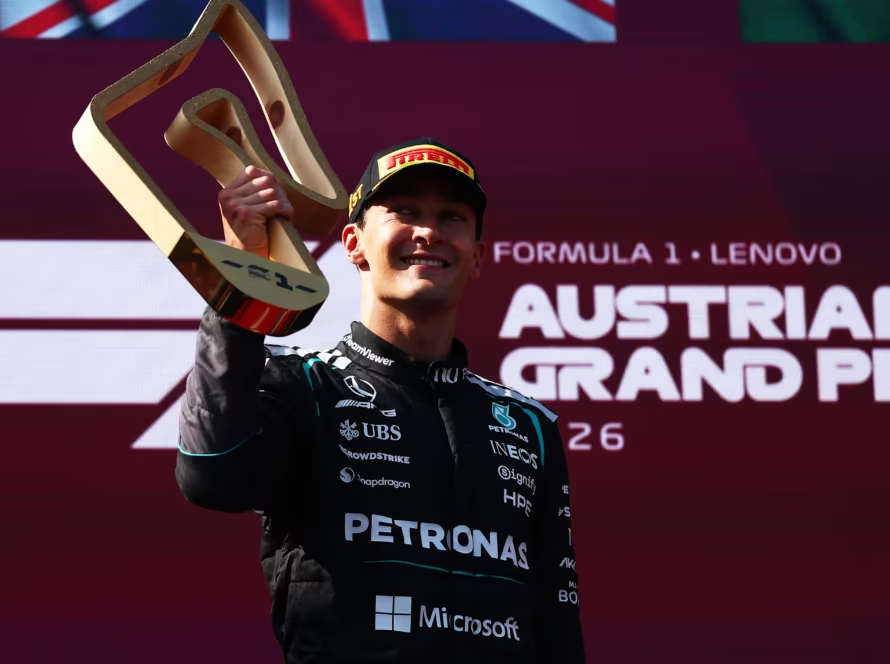
Mercedes AMG Petronas Formula 1 Team have always known how to build a dominant car. What it has found harder, across the years, is managing what happens when that dominance creates a battle from within.
The 2026 Barcelona-Catalunya Grand Prix offered the latest reminder. George Russell and Kimi Antonelli spent the closing laps racing each other while Lewis Hamilton, driving for Scuderia Ferrari, took the win. Toto Wolff did not mince his words afterwards: “We lost four, five, six seconds to Lewis [Hamilton], and that’s something we need to discuss with the drivers.” It was a measured comment with a weight that was clear to everyone.
For those who were fans of the Silver Arrows through the Hamilton-Rosberg years, the scene felt familiar.
A rivalry that rewrote the rules
The 2016 season remains one of the most gripping in recent Formula One history. It was not because of the championship outcome alone but because of how it was decided.
Lewis Hamilton and Nico Rosberg had shared a garage since 2013. For much of that time, the partnership worked. Mercedes produced remarkable F1 cars and two drivers delivered results. But the accumulated pressure of competing for a world title against your teammate, and childhood friend, in machinery where no one else could really touch you, eventually found its limits.
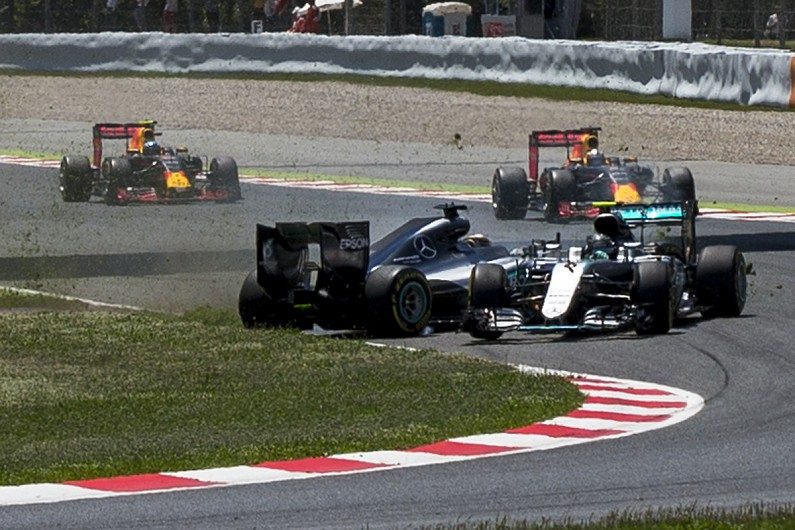
Barcelona 2016 was the moment the rivalry shifted from competitive to complicated. On the opening lap, Hamilton went for a gap that closed, ran wide onto the grass and spun into Rosberg. This led to both cars retiring and handing an eighteen-year-old Max Verstappen his first F1 victory on his Red Bull debut.
From there, contact, controversy and radio tension became recurring features of the season. In Abu Dhabi, Hamilton deliberately slowed at the front of the race to draw rivals onto Rosberg, defying repeated team orders. Rosberg won the championship in 2016 by five points.
Five days later, he retired.
James Vowles, who served as chief strategist at Mercedes through that era, has since described the framework the team built to manage the situation: equal opportunity, clear rules and a principle that the team’s interests came first. “We, at the time there, we want to win things by doing things just better than everyone else,” he said. Even the structure, he acknowledged, could not prevent the breakdown that came.
Different drivers, familiar dynamics
Russell and Antonelli are not Hamilton and Rosberg. They do not have the years of friendship where they grew up together, dreaming the same dream and eventually achieving it. Their dreams led to a bitter conflict that is still talked about, but they did it together. The parallel is simply structural, not personal.
Russell arrived in 2026 as the experienced driver and expected leader of the team. Antonelli, only nineteen and in his second season, was expected to develop steadily alongside him. What happened instead was a championship streak.
After Russell took the opening round in Australia, Antonelli won five consecutive races: China, Japan, Miami, Canada and Monaco. This made him the youngest championship leader since Alberto Ascari in 1953 and the first driver in the hybrid era to convert his first five pole positions into wins at the same events.
By Canada, Russell was 43 points adrift and had been forced to retire mid-race with a power unit failure. This result felt emblematic of how the season’s momentum had move entirely across the garage. Their sprint battle at that race featured several charged position swaps and a near-miss under braking. This added a physical dimension to what had been a building narrative.
Martin Brundle captured the shift well on Sky Sports F1, advising Russell to treat Antonelli as a peak Lewis Hamilton rather than a driver still finding his feet. It was a reframing that acknowledged something important: the rookie label no longer applied.
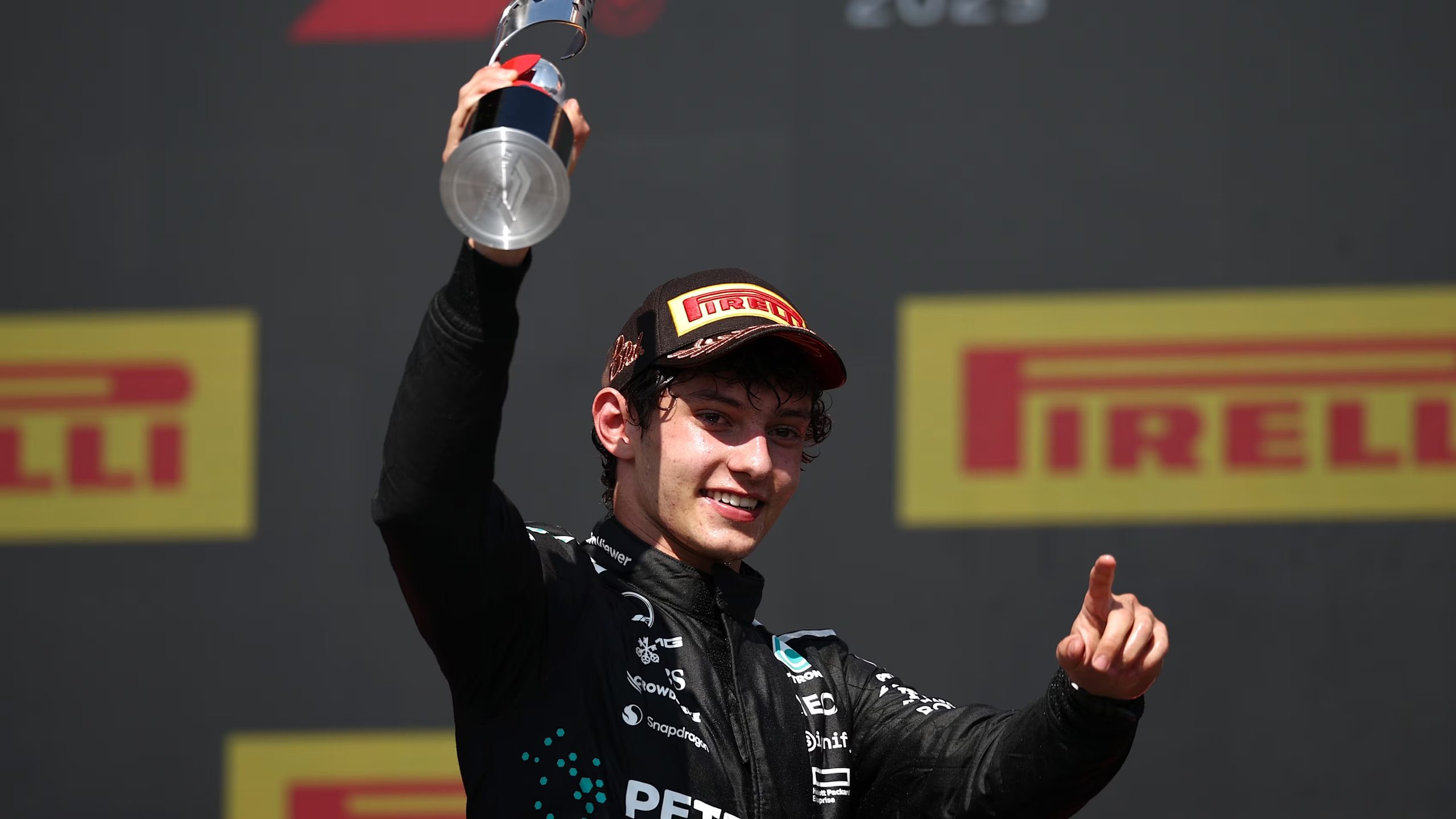
Antonelli himself has named the dynamic directly. Speaking at the Lorenzo Bandini Trophy event, he said the 2026 title fight could not become a repeat of the Hamilton-Rosberg era.
The external pressure Mercedes cannot ignore
What makes the Mercedes F1 intra-team situation more complex in 2026 is the presence of Hamilton at Ferrari.
In 2016, the external competition was real but ultimately insufficient to challenge Mercedes’ pace advantage. In 2026, Ferrari have closed the gap considerably. Hamilton’s win in Barcelona was not a surprise result born of chaos. It was earned and it was a signal. Every point dropped between two Silver Arrows is a point that Hamilton, 41 points behind Antonelli in the standings after Spain, does not need to manufacture.
Mercedes’ lead in the Constructors’ Championship remains solid. Both drivers are performing at a level the team can be proud of. But the season is long, the margins are tightening and the psychological weight of a title fight has a way of compressing what once felt like comfortable distance.
What comes next for the Mercedes team?
Mercedes AMG Petronas Formula 1 Team has the benefit of experience here. Toto Wolff has lived through what intra-team rivalry can cost, and the team’s communication around driver management has been notably more considered in 2026 than it was a decade ago.
The question is not whether Russell and Antonelli can coexist. They can, and they have. The question is whether that coexistence holds when the championship is decided by margins that a single Barcelona-Catalunya Grand Prix can swing.
Russell is quick, experienced and overdue a title shot. Antonelli is one of the most exciting young drivers the sport has produced in years. Mercedes has two genuine champions in its garage. The opportunity in front of them is significant.
History does not repeat itself. But it tends to rhyme when the conditions are right. In 2026, the conditions are starting to sound very familiar.