By the mid‑1980s, Hungary needed a way to demonstrate economic and cultural openness without crossing political lines, and Formula 1 became the medium. The country had become one of the more economically adaptable members of the Eastern Bloc, testing market reforms and Western partnerships while still operating within Soviet‑era constraints. What Hungary needed was a way to make that openness visible. Formula 1 offered exactly that: Western and globally televised, yet politically deniable, a cultural event rather than a geopolitical declaration.
The circuit that emerged from that moment reflects a delicate balancing act. Hungaroring was built quickly, eight months from concept to completion, because a rapid signal was needed. It was placed on farmland outside Mogyoród because the land was politically neutral, with no displacement and no industrial disruption. The circuit was designed with compact geometry because feasibility mattered more than evolution. The track needed to be modern enough for Western broadcast yet modest enough for Eastern scrutiny. Its tight rhythm comes from how it was built: limited time, limited equipment, and a layout that had to stay small and straightforward.
Where the layout reveals the politics
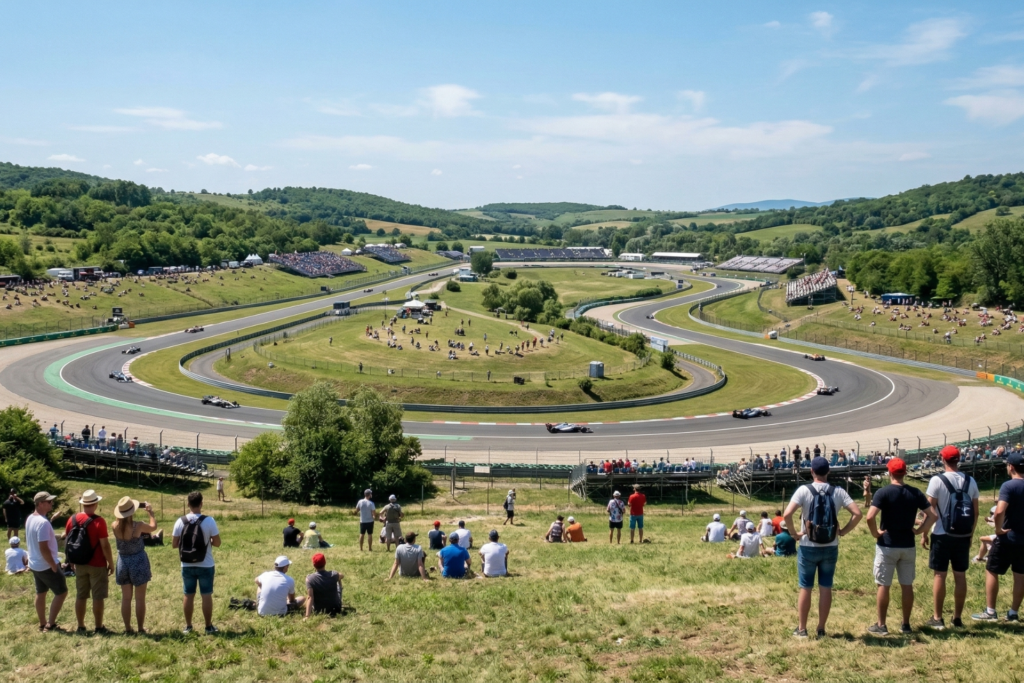
The circuit’s physical form is a direct product of the political conditions under which it was built. Hungaroring sits in a natural valley because the land was easy to secure and required no displacement or industrial negotiation. Its compact footprint comes from the need to deliver a modern‑looking venue without appearing extravagant or wasteful. The tight, continuous rhythm reflects a build completed with limited machinery and minimal earthworks, a layout shaped more by what could be done quickly and quietly than by any motorsport philosophy. Even the amphitheater‑like geometry served a political purpose: it made the circuit highly visible on television, which was the real objective. What began as a design shaped by diplomatic caution now functions as a demanding environment for modern cars, trapping heat, collecting dust, and compressing the lap into a sequence that still carries the imprint of its origin.
The opening sector sets the tone. The short main straight drops into Turn 1, the only reliable overtaking point, and the sequence through Turns 2 and 3 immediately punishes any driver who fails to secure position. The middle sector is an unbroken chain of medium‑speed direction changes beginning at the blind crest of Turn 4. There are no reset points and no straights to cool tyres, and a small mistake at the Turn 6 and 7 chicane carries through the entire run to Turn 11. The lap ends with three long, low‑speed corners where mechanical grip determines everything. Turn 14, a full 180‑degree right‑hander, exposes any driver who has over‑used the tyres earlier in the lap.
The discipline the track demands
Its origin story still shows up in the racing. Hungaroring behaves like infrastructure shaped for television rather than for modern racing flow. The narrow margins, the continuous sequences, and the absence of reset points force teams into a mode that mirrors the circuit’s political birth. They operate within limits, extract value from stability, and treat clarity as a structural factor. The track rewards coherence over aggression and operational consistency over raw pace. Drivers feel the legacy as a lap that punishes deviation and limits overtaking windows. Teams feel it as a weekend where the usual competitive order shifts and strategy outweighs power.
Strategy at Hungary is shaped by the circuit’s limits. Teams advance through timing and consistency rather than bold moves because the layout simply does not offer them. The sport has changed and the cars have changed yet Hungaroring continues to filter performance through its constraints. The circuit rewards teams with coherent internal systems, stable balance, and predictable tyre behaviour.
A track that outlived its moment
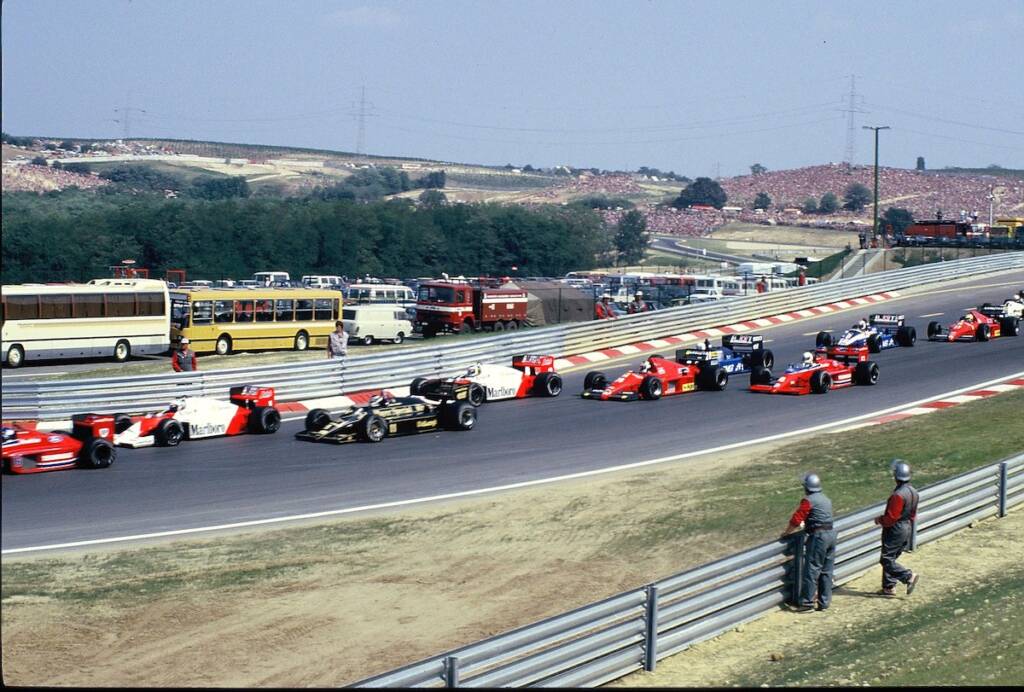
Hungaroring’s modern legacy is the tension between what it was built to signal and what it is now asked to host. Modern Formula 1 circuits are designed for spectacle, overtaking, and commercial scale. Hungaroring was designed for legibility. That difference still matters. It is why midfield cars qualify out of sequence and why operational culture becomes more important here than aerodynamic superiority.
Hungaroring is a geopolitical artifact that never stopped communicating. The Cold‑War moment that produced it is gone, but the design logic remains controlled and broadcast‑friendly. Modern Formula 1 has evolved into a system of power and aerodynamic complexity, yet Hungary still forces the sport into a mode shaped by its origin.
Where the past meets the weekend
Hungaroring’s behaviour also gives a clear sense of what to expect this weekend. Qualifying will carry unusual weight because track position is one of the few advantages the circuit reliably preserves. The opening sector offers the only meaningful overtaking window, and even that depends on cooperation from the car ahead, so teams will treat Saturday as the real battleground. Once the race begins, progress tends to come through timing and consistency. The middle sector’s continuous rhythm makes it difficult to generate pace on demand, and cars that try to manufacture opportunities usually pay for it through tyre wear or broken flow. Drivers who settle into a steady rhythm will look stronger than those who rely on instinctive aggression, because the lap rewards repetition and micro‑adjustment.
Heat will shape the weekend as well. The valley traps temperature and dust, pushing tyres out of their operating window faster than simulations predict. Cars that rely on high‑energy cornering loads will struggle to maintain balance across a stint, while teams with predictable tyre behaviour will find themselves in control. In the end, Hungary tends to reveal organisational culture more than outright pace. The teams that understand constraint, manage heat, and maintain discipline rise naturally, while those that depend on opportunism or raw power find the circuit uncooperative. Hungaroring still rewards the same qualities it was built to project: patience, clarity, and coherence.