For decades, women in motorsport have faced the same uphill battle: breaking into a sport where funding, visibility and opportunity have often mattered just as much as talent. With the last woman to start a Formula 1 Grand Prix doing so in 1976, it became increasingly clear that talent alone wasn’t enough.
W Series and F1 Academy were both created to change that. Although they share the same goal of getting more women into motorsport, their approaches couldn’t be more different. One broke down barriers to entry, while the other has focused on building a clearer pathway beyond them.
W Series: The championship that changed the conversation
When the W Series launched in 2019, it was built around tackling one of the biggest barriers facing aspiring racing drivers: funding. Unlike most junior single-seater championships, where a driver’s career is often heavily influenced by their ability to secure sponsorship, W Series offered free entry and covered the costs of competing for its selected drivers.
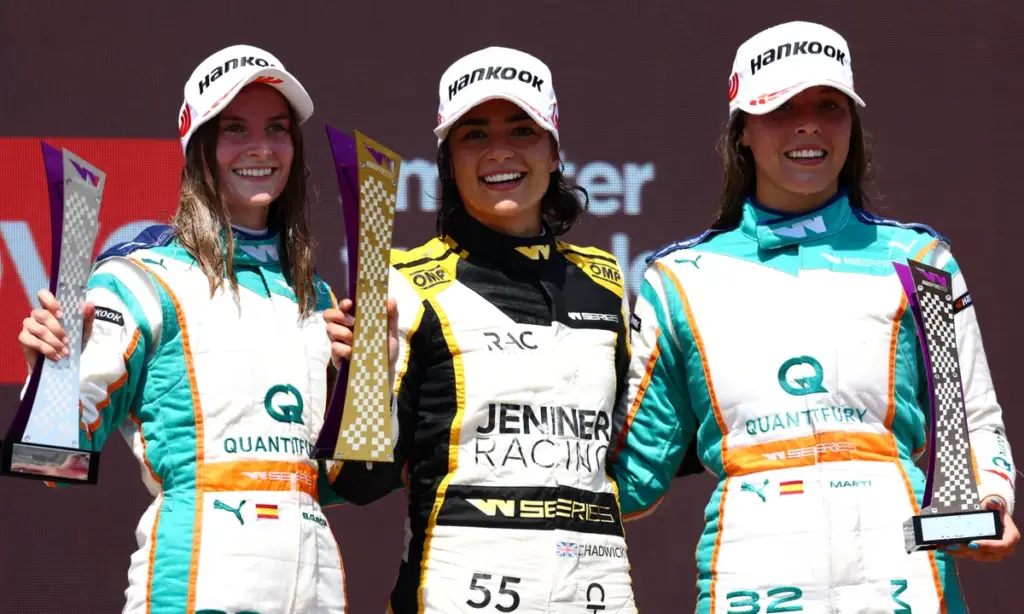
The idea was straightforward: create a championship where talent, rather than financial backing, determined who earned a place on the grid.
The inaugural season featured 18 drivers competing in identical Tatuus T-318 Formula 3-spec cars, with the championship racing alongside high-profile events including several Formula 1 weekends. One of W Series’ main selling points was that drivers competed in regional Formula 3-spec cars, aligning the championship with the level many hoped to progress into next, while also racing on the same circuits and Grand Prix weekends as Formula 1.
It gave female drivers a dedicated platform and brought increased visibility to a group that had historically struggled to access opportunities in single-seaters.
The series quickly produced recognisable names, with British driver Jamie Chadwick becoming its defining figure. Chadwick won the first three W Series titles between 2019 and 2022, establishing herself as one of the championship’s standout performers.
However, W Series’ biggest strength also highlighted its biggest challenge. While it successfully removed the financial barrier to entering the championship, progression beyond it remained complicated. Motorsport’s traditional ladder is expensive and moving from W Series into categories such as Formula 3 or Formula 2 still required significant funding and opportunities.
The championship proved that talented female drivers could compete at a high level, but it raised a bigger question that creating opportunities was only one part of the solution. The next challenge was building a pathway that allowed those drivers to continue climbing.
F1 Academy: Building a pathway from the ground up
F1 Academy launched in 2023 as a response to some of the challenges highlighted by the W Series, particularly around long-term progression after the championship itself. While W Series provided female drivers with a competitive platform and removed the immediate financial barrier of entry, F1 Academy was designed around developing talent earlier and creating a clearer route through the junior single-seater ladder.
The series uses Tatuus T-421 Formula 4 cars, placing it below the Formula 3-spec machinery used by W Series. This means F1 Academy is aimed at drivers who are still establishing themselves in single-seaters, with many competitors arriving from karting or entry-level formulas rather than after several years of junior racing.
The difference can be seen in the structure of the championship. F1 Academy follows a format closer to other junior categories, with three races taking place across a race weekend. Alongside the feature race and the reverse-grid race, it creates more opportunities for drivers to gain race experience, showcase their talents and increase their visibility throughout an event.
Wild Card entries are a welcome addition to F1 Academy, allowing one driver outside the main grid to compete in a designated car in every round. The programme is designed to broaden the pool of talent entering the series, giving promising racers from regional championships the chance to experience F1 Academy machinery and compete against established drivers.
By focusing on younger talent, increased track time and wider access to the grid, F1 Academy has taken a more development-focused approach, aiming to build drivers from the early stages of their careers rather than simply providing a platform once they have already reached a certain level.
Marta García, Abbi Pulling and Doriane Pin are among the most successful drivers to emerge from F1 Academy. Despite taking very different routes after their time in the championship, each has continued to build on their success, showcasing the range of opportunities the series can create.
How F1 Academy refined the formula
F1 Academy was created with the benefit of hindsight. The W Series proved there was an appetite for women’s motorsport and created a platform for female drivers, but it also highlighted that visibility and opportunity needed to be supported by a longer-term structure.
One of the clearest differences is the level of investment in building an audience around the championship. W Series benefited from racing alongside Formula 1 weekends, but F1 Academy has placed visibility at the centre of its strategy. Its calendar is closely tied to Grand Prix events, while the launch of its own Netflix docuseries, F1 Academy, follows a similar approach to Drive to Survive by bringing fans closer to the drivers and their stories.
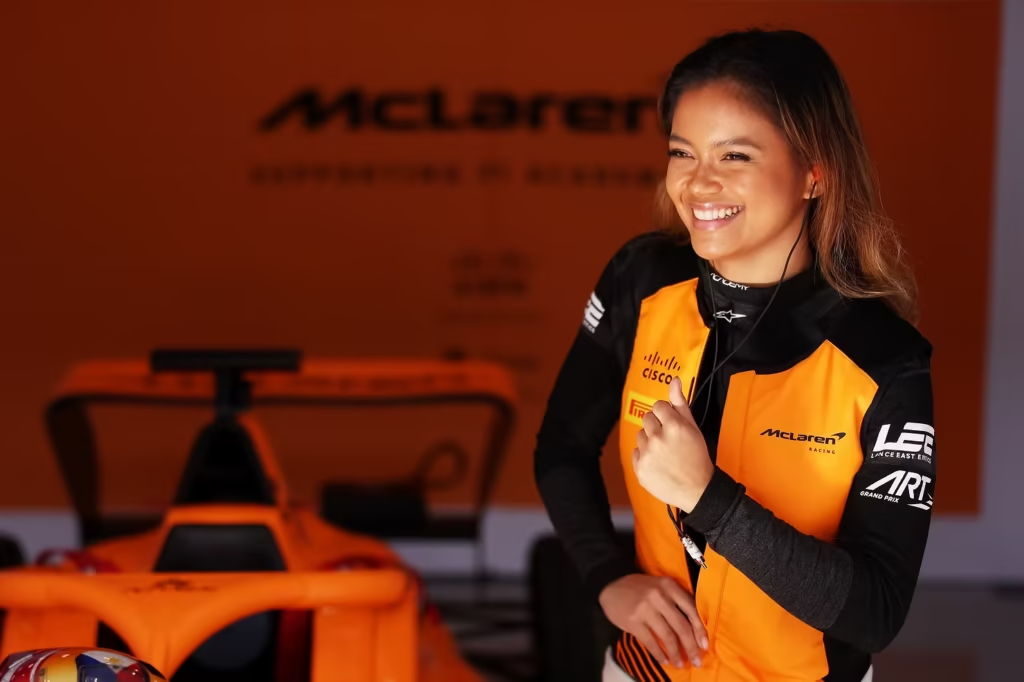
This focus on storytelling reflects a wider commitment to making female drivers recognisable beyond the racetrack. Bianca Bustamante, who competed as part of the McLaren Driver Development Programme during her F1 Academy seasons, became one of the championship’s most recognisable figures, building a following of 1.8 million on social media before progressing into EuroCup 3. Her rise highlights how the series has invested not only in developing drivers, but also in building the audience and commercial appeal of women’s motorsport.
The series has introduced changes designed to keep the grid evolving, including its two-year participation limit and Wild Card programme. By encouraging drivers to move onwards and creating additional entry points for new competitors, F1 Academy is attempting to avoid some of the stagnation challenges seen in previous women-only championships.
Ultimately, the difference lies in the scale of the project. The W Series was pioneering in proving that female drivers could attract attention and compete at a high level. F1 Academy has taken that foundation and built a wider ecosystem around it, combining driver development with the commercial reach needed to sustain interest in women’s racing.
The route after the championship
The biggest test for both championships is what happens after the title is won. W Series successfully raised the profiles of its drivers, with Jamie Chadwick becoming the series’ defining figure after winning three titles between 2019 and 2022. However, her career also highlighted the difficulty of progressing beyond a women-only championship, with funding and opportunities still proving a challenge as she moved into Indy NXT before later joining the European Le Mans Series with Genesis.

F1 Academy has attempted to create a more defined route beyond the championship. Doriane Pin’s career demonstrates this shift, with the French driver progressing from F1 Academy success into Mercedes’ junior programme, before becoming the first F1 Academy graduate to test a Formula 1 car when she drove Mercedes’ W13 during a test at Imola in 2025.
However, the true measure of both championships will be whether their graduates can consistently progress into higher levels of motorsport. Creating successful champions is one achievement; creating a pathway where those drivers can continue climbing the ladder is the challenge that will define their long-term impact. Ultimately, W Series and F1 Academy represent two stages of the same movement: one challenged the barriers preventing women from entering motorsport, while the other is attempting to build the structure needed to help them progress beyond it.