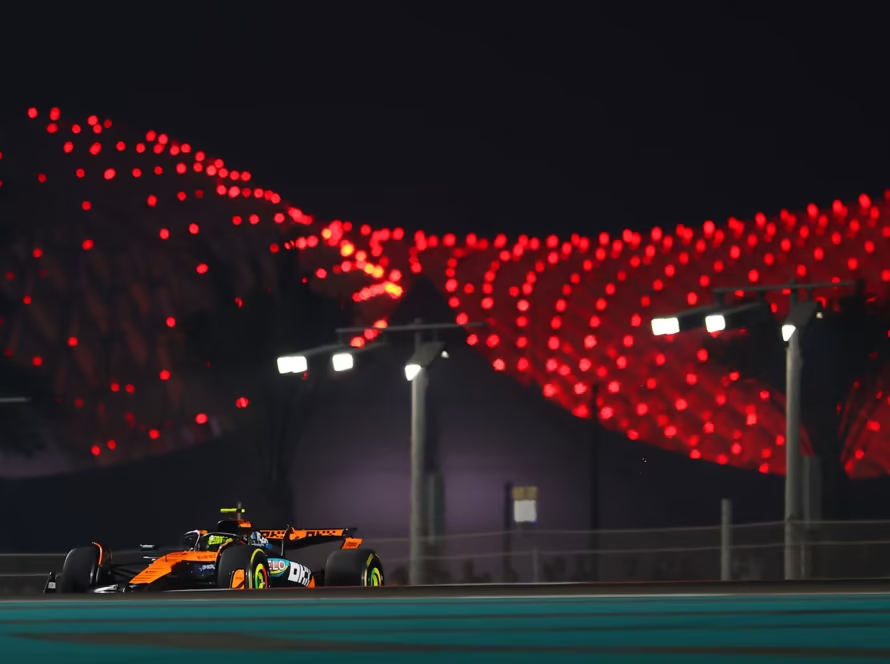
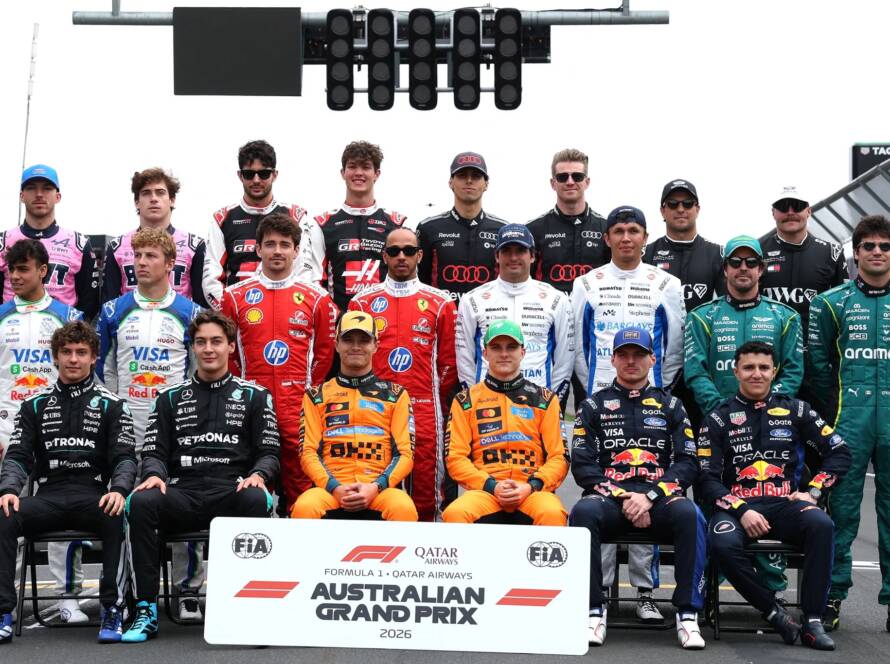
Mercedes’ 2026 dominance swept every qualifying session across the first ten weekends of 2026 and won six Grand Prix in a row before anyone else got a look in. By the time the paddock broke for the summer, that opening barrage already felt like it belonged to a different season entirely. Mercedes 2026 dominance was, for a while, the only story in Formula 1. It just didn’t stay that way.
The 2026 Mercedes dominance that nearly wasn’t
The signs were there from winter testing. Mercedes rolled out a car with a strong chassis, a powerful engine, and energy deployment that looked to dominate the 2026 season under the new active-aero, 50/50 power unit regulations, evoking memories of the team’s 2014 hybrid-era takeover.
Australia confirmed it. George Russell converted pole into victory, with a suddenly transformed Kimi Antonelli right behind him. Antonelli then took the baton and ran with it, winning in China, Japan, Miami, and Canada before completing five straight victories in Monaco, becoming the youngest winner around the streets in the process.
For a rookie who’d had a difficult first season, it was a remarkable turnaround, and it built him a championship cushion that looked, at the time, close to unassailable.
Where the cracks started showing

Barcelona ended the run. Ferrari took its first win of the year there, and it turned out to be the first crack in a wall that had looked seamless. Reliability failures followed at Silverstone and again heading into Hungary and Spa, with battery pack issues forcing Mercedes into a fix that will cost the team grid penalties later in the year.
Russell’s second half of the campaign got harder too. He carried a mysterious straight-line speed deficit into Silverstone before his race ended on the opening lap in contact with Hamilton, then qualified and finished seventh in Hungary. By the summer break, he sat 59 points behind his own teammate, several of those points lost to circumstances that weren’t really his fault at all.
Meanwhile, the rest of the grid stopped standing still. McLaren and Ferrari made real strides on the chassis side, closing a development gap that had looked enormous in March. Technical Director James Allison later explained the mechanics of it on the team’s Nu Silver Arrows Radio Show: because the sport’s Aerodynamic Testing Restrictions tie wind tunnel and CFD time to prior finishing position, rivals who locked in their launch cars earlier were able to pivot into mid-season development sooner, while Mercedes stayed out of phase with the rest of the grid’s upgrade cycle.
With the entire field finding close to half a second of lap time every two months under brand new rules, that phase gap mattered. Toto Wolff summed up where that leaves the team bluntly, noting it’s “going to be a development fight going forward.” By the time the season actually reached the summer shutdown, Mercedes had won only two of the six races since that opening streak ended.
Zandvoort made it official
If Barcelona cracked the wall, Zandvoort knocked a chunk out of it. F1 returned from the break at the Dutch Grand Prix, the event’s farewell running before it drops off the calendar, and Mercedes’ 2026 dominance was expected as they arrived as favourites. Russell took pole for Saturday’s sprint and won it, but Sunday told a different story.
The race was red-flagged after one lap when Max Verstappen crashed out of his own home event, and once it resumed, Antonelli held the lead for most of the afternoon. McLaren gambled on a tyre offset, sending Norris long on the hard compound. On lap 54 he swept around the outside of the championship leader before dispatching Hamilton’s Ferrari moments later. This gave him the race lead earned on merit, before he went on to win the race.
Russell finished third behind his own teammate, in a weekend that also saw Mercedes lean on team orders, which Russell himself later called the right decision. It was Norris’s second win in a row. Combined with his pole in both, it meant Mercedes had lost the front row on merit at the two most recent grands prix. Whatever had gone soft in the Mercedes package before the break plainly hadn’t fixed itself over it.
Enter ADUO, the FIA’s Insurance Policy Against a Runaway Engine

Underneath the on-track story, there’s a regulatory one that explains just as much about where Mercedes 2026 dominance is headed. Introduced under Article C4 of this year’s technical regulations, the FIA’s new Additional Development and Upgrade Opportunities system (ADUO) exists specifically to stop one power unit manufacturer running away with the format the way Mercedes once did in 2014.
Any manufacturer whose internal combustion engine falls more than 2% behind the class-leading benchmark during a set review window earns extra homologated upgrades across the current and following season, plus more dyno hours and a higher cost cap. Fall more than 4% behind, and the concession maxes out.
The first review period, covering the season up to Canada, found Mercedes sitting 2 to 4% off the pace on ICE performance, enough to earn Brackley one additional homologation for 2026 and another for 2027. Ferrari, Honda, and grid newcomer Audi were all judged to be more than 4% adrift, unlocking the maximum allowance of two extra homologations apiece across both years, along with the accompanying testing and budget relief.
FIA Single-Seater Director Nikolas Tombazis was careful to keep manufacturer specifics confidential while confirming the process will keep changing, saying only that “there are areas which we may evolve over time.” Tellingly, the second review window, running through Hungary, produced no further grants to anyone, a sign that the gap on power unit performance had already started tightening on its own.
The third window is already open and running from Zandvoort through Mexico City, meaning the second half of the season will decide whether Mercedes needs the FIA’s help closing the gap again.
It’s a strange position for a team that still leads both championships by a wide margin to be in. Mercedes built its 2026 car around an engine advantage. The very system designed to protect competitive balance has already ruled that its rivals deserve a leg up to catch it. Add that to McLaren and Ferrari’s chassis gains, and the squeeze is coming from two directions at once rather than one.
What this means for the rest of 2026, and beyond
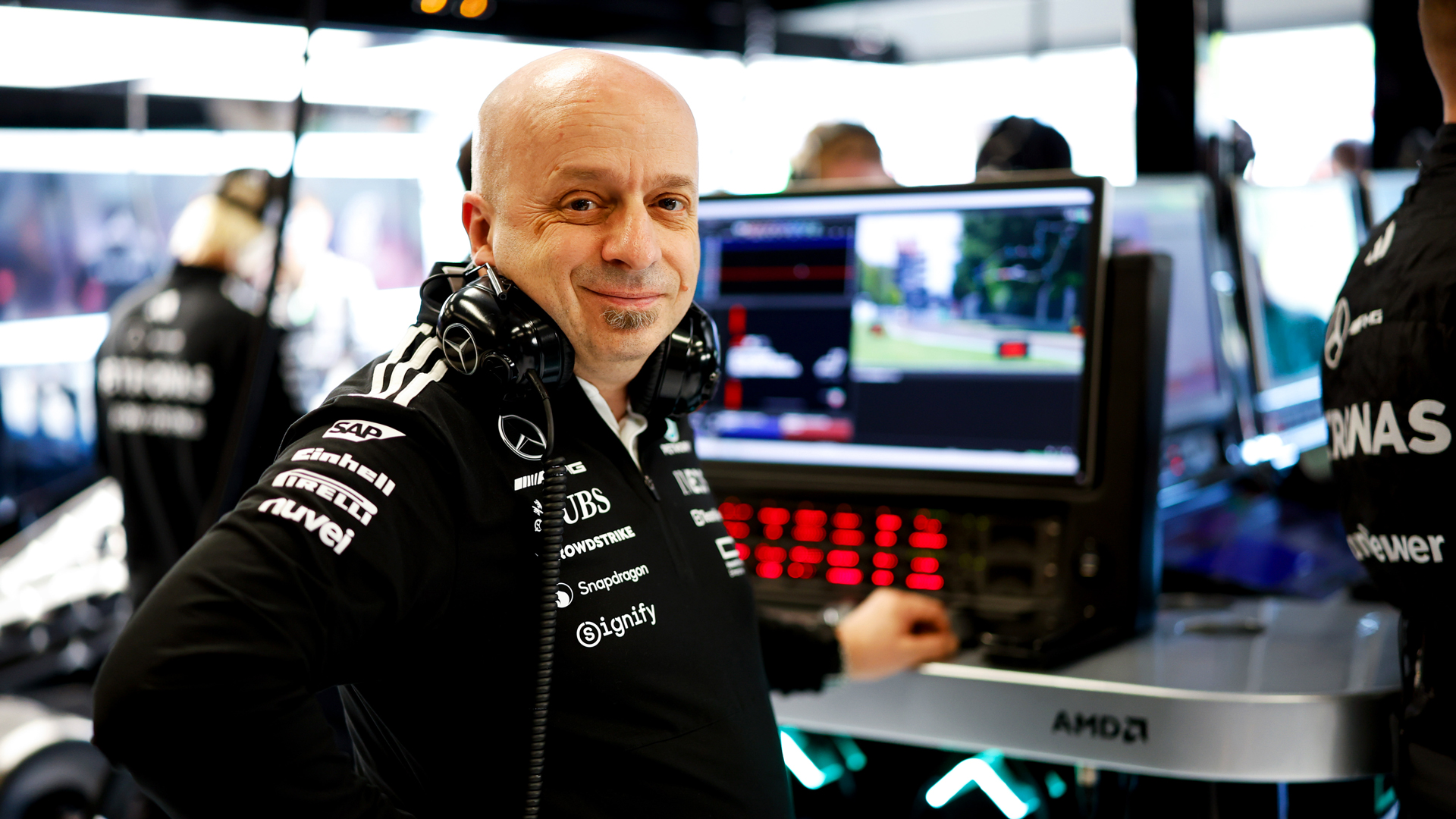
None of this means the title is gone. Mercedes’ 2026 dominance led to a healthy points advantage that still holds up. Deputy Technical Director Simone Resta put it heading into the second half of the year, “there is still a long way to go.”
He’s not wrong. History backs him up too, since championship momentum in this sport has a habit of shifting after the summer shutdown almost as often as it doesn’t.
However, the shape of the fight has changed. In the standings after Zandvoort, Hamilton and Russell are on the same points for second, Norris is closing in from fourth. Antonelli’s lead over his own teammate has become nearly as significant as his lead over the field.
What looked in April like a rerun of 2014’s one-team domination now looks like the opening chapter of something closer to 2021 or 2022, a season decided by whoever manages development, reliability and a still-evolving rulebook best over the remaining rounds.
Under active aero, a 50/50 power split and a homologation system explicitly built to keep any one manufacturer from running away. That’s probably exactly how the FIA wanted it to go.